
AI recruitment isn’t futuristic; it’s already embedded into the talent acquisition playbook of leading companies. From Fortune 500 multinationals to nimble startups, hiring teams are leveraging machine-driven tools to automate sourcing, screen resumes, and even conduct interviews. But for CEOs and hiring managers striving to win the talent war, relying solely on technology brings both upside and unspoken risk.
Let’s unpack the perks and pitfalls of reliance on technology in recruitment and why a thoughtful, human-forward approach (like WorkRocket’s) can change the game.
Table of Contents
Why AI Recruitment Is Exploding in 2026
Before we talk downsides, let’s acknowledge why AI tools have become so popular:
- 44% of organizations now use AI for recruiting and hiring tasks. This is up from prior years as more companies automate candidate screening, interviewing, and matching.
- AI reduces time-to-hire by up to 50% and slashes recruitment costs by about 30%.
- 92% of companies plan to increase their AI investment in the next three years.
In short: AI recruitment is providing scale, speed, and measurable efficiency; exactly what modern talent teams crave in a competitive labor market.
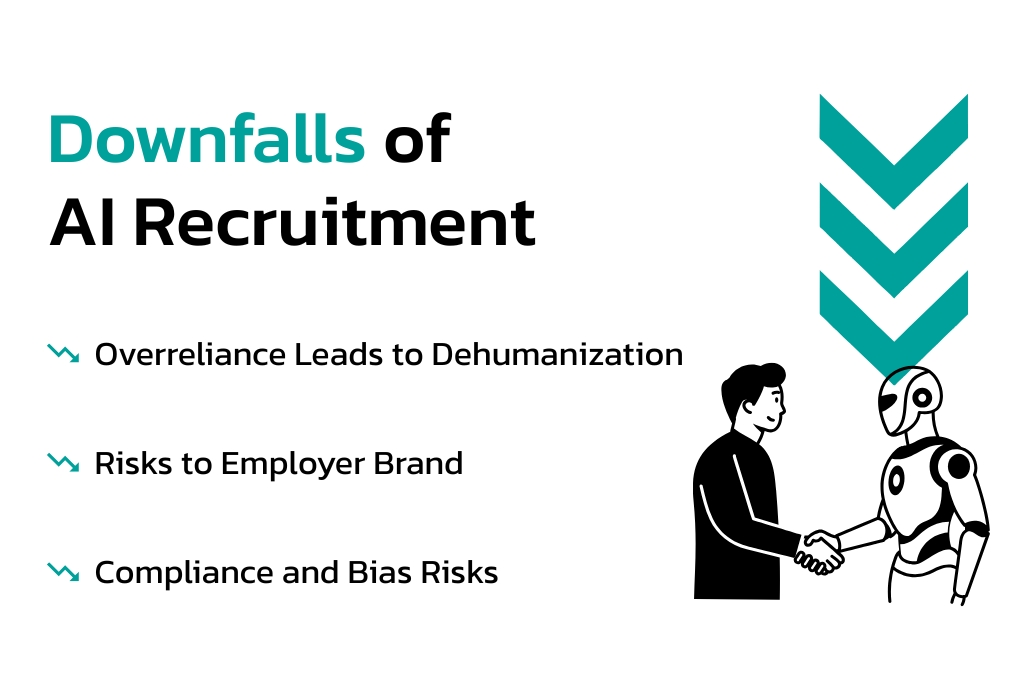
Downfall #1: Overreliance Leads to Dehumanization
AI inherently treats applicants as data points; structured, measured, and categorized. That’s efficient, but it’s not human.
In recruitment:
- AI might screen out candidates with unconventional career paths simply because a model doesn’t “see” the potential.
- AI doesn’t gauge cultural fit, ambition, grit, or alignment with company values; yet those are often the differences between a good hire and a great one.
AI treats applicants as data points; WorkRocket treats them as decisions with consequences.
The stakes in hiring go far beyond filling a seat. The wrong hire disrupts teams, degrades culture, and drains productivity. Only humans can weigh the holistic aspects AI overlooks.
Downfall #2: Risks to Employer Brand
Many companies don’t realize how recruitment experiences shape their brand. When candidates feel ghosted, misunderstood, or judged by a soulless algorithm, your employer value proposition erodes.
AI may expedite candidate communication, but it may also:
- Deliver impersonal responses.
- Leave candidates feeling dismissed without context.
- Generate frustration when decisions aren’t transparently explained.
This brings us to our next point: AI cannot protect a company’s employer brand; WorkRocket builds and protects it.
WorkRocket prioritizes candid, personalized engagement that reflects your brand values and makes candidates feel seen, not screened.
Downfall #3: Compliance and Bias Risks
The promise of bias reduction is real, but so are legal and ethical risks.
As of 2025, many HR professionals cite algorithmic bias as a top concern, and a significant share of organizations audit or halt AI tools for fairness due to bias findings.
This underscores a key point:
If AI decisions aren’t explainable or auditable, companies risk discrimination claims and damaging legal exposure.
A human-centered approach, combined with ethical oversight, helps safeguard compliance and fairness across every hire. You can’t outsource moral judgment to a model.
Potential Positives of AI Recruitment
AI-powered recruiting can offer three advantages at scale: speed, prediction, and the potential to reduce bias.
First, AI systems excel at handling massive applicant volume by rapidly scanning and ranking resumes, sourcing candidates across platforms, and automating scheduling and follow-ups; capabilities that are essential for CEOs and hiring leaders managing multiple openings.
However, while AI solves volume, WorkRocket finds real people by adding focus, context, and relevance, ensuring that strong candidates aren’t overlooked simply because their full story didn’t fit neatly into the data.
Second, AI-driven predictive analytics can improve candidate matching by analyzing historical hiring patterns, skills, and performance correlations, with reports citing gains such as 67% higher relevance and faster screening for 75% of recruiters.
However, AI predicts patterns, not motivations, whereas WorkRocket uncovers why candidates care about your mission, culture, and long-term impact; insights that define top talent but remain uniquely human.
Third, when designed carefully, AI can help reduce bias in early screening by leveraging diverse datasets, though this benefit is not guaranteed, as poorly designed systems can inherit or amplify bias at scale.
2025 academic research even highlights a risk where AI-to-AI interactions may favor AI-generated resumes over human-authored ones regardless of true candidate quality.
Together, these dynamics reveal both the power and the limits of automation, underscoring why human judgment remains critical alongside AI.
Reality Check: Human + Machine, Not Machine Only
If there’s one thing hiring leaders are learning in 2026, it’s this:
AI is powerful but it’s not a replacement for human strategy.
AI handles repetitive, high-volume tasks. But humans interpret nuance, make judgment calls, and build relationships.
AI removes friction; WorkRocket creates connection.
AI fixes for patterns; WorkRocket crafts stories.
AI is built for the masses; WorkRocket is built for your unique, specific job that requires a story.
When nuanced judgement calls are important, human understanding gives you an advantage.
Summary: Where AI Shines and Where It Struggles
Strengths of AI Recruitment:
- Massive volume processing
- Faster resume screening
- Early pattern matching
- Basic filtering and prioritization
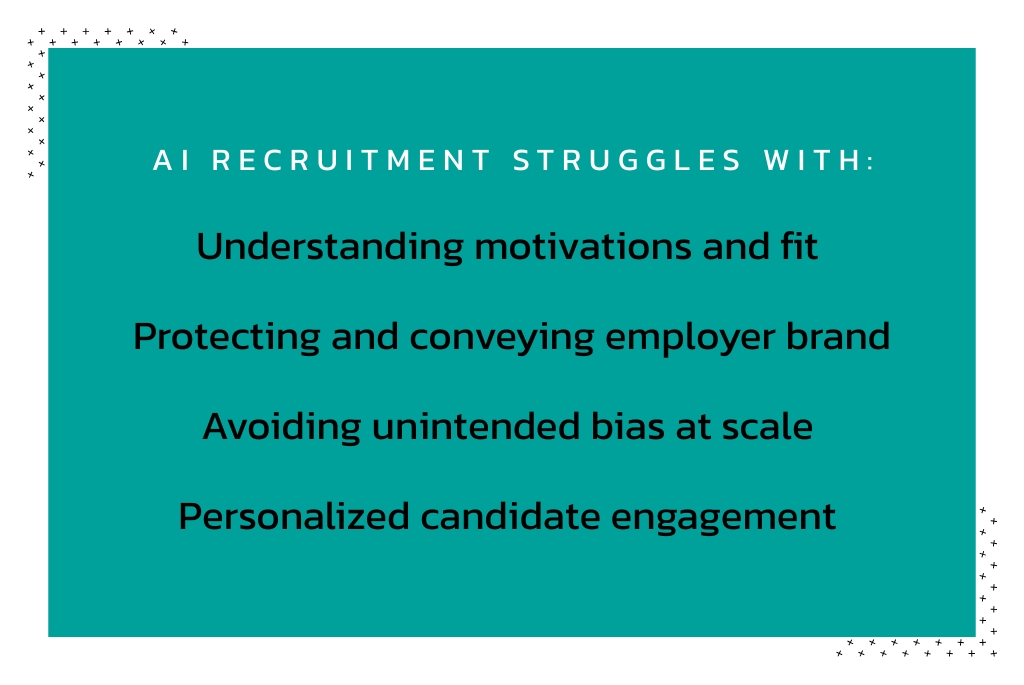
Struggles of AI Recruitment:
- Understanding motivations and fit
- Protecting and conveying employer brand
- Avoiding unintended bias at scale
- Personalized candidate engagement
For CEOs and hiring managers, the implication is clear:
AI is a force multiplier but not a decision maker. Rely on it for scale but couple it with human expertise for true impact.
The Strategic Advantage: Craftsmanship Over Commodity
Indeed and other major job search platforms are using AI to navigate today’s labor marketplace. That’s valid and valuable for broad sourcing.
But WorkRocket operates differently:
- AI solves volume; WorkRocket solves clarity.
- AI predicts patterns; WorkRocket uncovers motivations.
- AI is built for the masses; WorkRocket is built for your unique hiring story.
- AI removes friction; WorkRocket creates connection.
When it’s time to hire not just someone, but the right one, that’s where human strategy, persuasion, and network craft matter most.
And as many CEOs know, quality talent is the engine of growth.
Conclusion: Don’t Let Tech Dictate Your Talent Strategy
Building a modern hiring approach doesn’t mean surrendering to technology.
Instead, it means:
- Using AI to amplify efficiency
- Resisting the urge to let automation own decisions
- Infusing human judgment where it matters most
- Protecting your employer brand through connection
- Choosing partners like WorkRocket that balance tech and talent craft
CEOs and hiring managers should be optimistic about technology, but clear-eyed about its limitations.
At the end of the day, the smartest organizations in 2026 and beyond will be those that marry AI speed with human insight.
