
Automating your hiring can speed up the recruitment process, but a faster process doesn’t automatically mean better hiring.
A scheduling tool can save time. A resume parser can organize applicants. A chatbot can answer basic questions. These tools can help when the hiring process is overloaded, repetitive, or too slow.
But risk starts to enter the picture when automation moves from supporting the hiring process to replacing the human judgment that makes the process work. Hiring still depends on context, trust, conversation, and accountability. If those parts of the process disappear, the company may risk missing qualified people, frustrating candidates, or making decisions based on signals that don’t actually predict success.
Employers shouldn’t necessarily avoid hiring technology completely, but you need to know where automation helps and where a human being offers the most value.
Table of Contents
Let Humans Define the Role
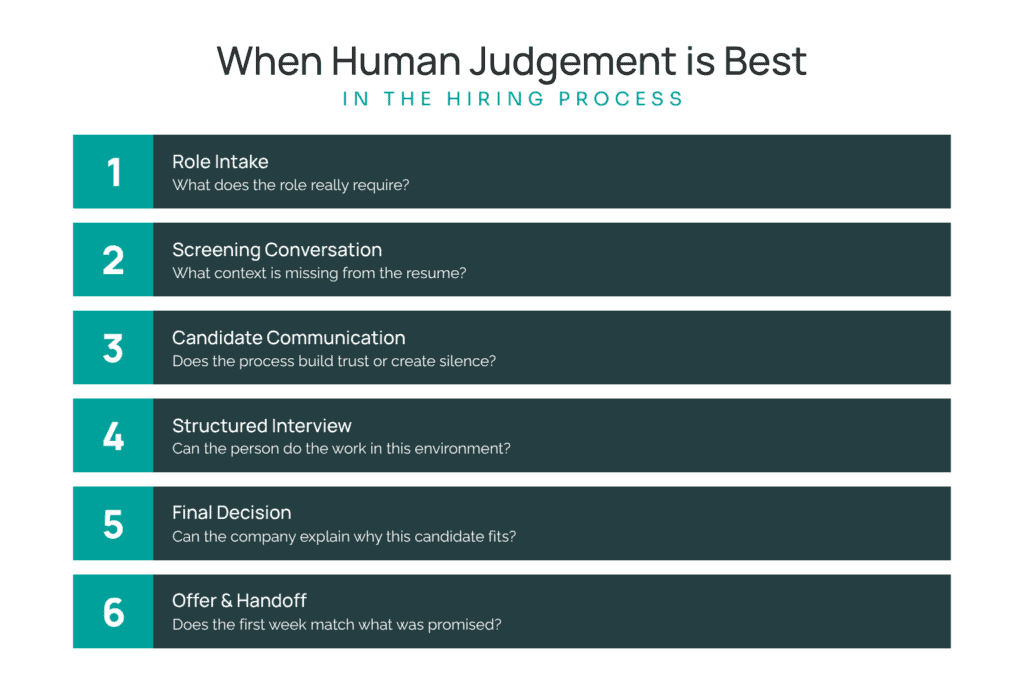
Automation can help write a job post, organize requirements, or compare skills across resumes, but it shouldn’t decide what the role really needs.
That decision requires business context. A hiring manager may know that the last person struggled because the schedule changed, the equipment mix shifted, the supervisor needed stronger communication, or the posting overemphasized a credential that wasn’t essential. Attention to details like this matter because they shape who should be screened in and who shouldn’t be filtered out too early.
This is where over-automation can create a hidden problem. Harvard Business School research on hidden workers notes that applicant tracking systems used by 98% of Fortune 500 companies and many other employers can screen out candidates with employment gaps, missing academic credentials, or limited recent full-time work history.
While this filtering may look efficient on the surface, it can remove people who are missing requirements that didn’t actually matter.
A stronger hiring process may use automation to organize information, but keeps people responsible for defining the must-haves, separating them from preferences, and deciding which tradeoffs are acceptable.
Screening Needs More Than Keyword Matching
Screening is one of the easiest parts of hiring to automate, but it’s also one of the easiest places to lose good candidates.
A resume rarely tells the candidate’s whole story. It may not explain why someone left a role, whether they can work a specific shift, how they handled a similar work environment, whether they’re open to the commute, or what they want next. A human screening conversation can catch those details before the candidate is passed forward or rejected.
Automation can help by sorting applicants, flagging minimum qualifications, and making the process more consistent. But when screening becomes too rigid, employers can reject candidates who may have been worth a conversation.
Automation in this part of the process can also invite legal risk into the equation. In the EEOC’s iTutorGroup case, the agency said the company’s recruiting software rejected more than 200 qualified U.S. applicants because of age. The company later agreed to pay $365,000 to settle the lawsuit, according to the EEOC’s settlement announcement.
Not every automated tool is discriminatory, but the lesson here is that employers are still responsible for what their tools do. Without careful use, these tools can expose your business to more risks.
Screening should be structured, documented, and consistent. It should also leave room for trained people to review edge cases, ask follow-up questions, and recognize when a candidate’s experience still fits the role despite their resume missing the proper keywords.
If your team has limited bandwidth for tasks like this, services like WorkRocket’s phone screening and resume screening services are alternatives to automated processes that expand your hiring team’s bandwidth without removing the human element of the process.
Candidates Want Real Conversation, Not Automated Messages and Chatbots
During the hiring process, candidates are judging the employer as much as the employer is judging them. Every message, delay, interview, rejection, and follow-up tells them something about how the company operates.
Automation can improve communication when it prevents silence. Confirmation emails, status updates, scheduling links, and reminders can make the process feel cleaner and more reliable. But fully automated communication can also make candidates feel like no one is actually paying attention.
A 2025 study on AI-driven hiring found that applicants in AI-led processes reported lower trust, less interactive communication, reduced organizational attraction, and lower intent to apply. The study, published by Springer, examined how trust and procedural justice affect applicant reactions to AI hiring.
We commonly see these issues arise when the candidate has questions that the system can’t answer well, such as:
- What’s it like to work on this team?
- Why is the role open?
- What does success look like in the first 90 days?
- How flexible is the schedule?
- What happened to the last person in the seat?
These are questions that candidates ask to gain insight into your company and to decide whether they can trust your organization. An impersonal or incomplete answer from a chatbot or automated message may erode trust where a person could have used the opportunity to build confidence with the candidate.
Interviews Need Human Judgment
Poorly structured interviews can create inconsistency and bias, but using automated systems to create consistency without human judgement is another problem entirely.
Structured human interviews can be valuable because they combine consistency with context. The company can ask each candidate the same core questions, compare answers against the same criteria, and still allow a trained interviewer to listen for examples, clarify responses, and evaluate how the candidate thinks.
Research published by Cambridge University Press noted that structured interviews showed strong validity and lower racial group impact than several other top selection predictors. The real solution is to improve the interview process instead of replacing it with a fully automated decision.
For employers hiring skilled trades, technicians, field service employees, manufacturing workers, customer-facing roles, or specialized professionals, the interview often has to evaluate more than just surface level answers to questions. The process needs to test judgment, reliability, communication, work preferences, and fit with the environment. A human is more likely to pick up on subtle queues that show the candidate’s capability in these areas than an automated system that’s just running through a list of questions and gathering answers to them.
Final Hiring Decisions Need Accountability
The final hiring decision shouldn’t be handed entirely to software.
Pew Research Center found that Americans oppose employers using AI to make final hiring decisions by a 71% to 7% margin. The U.S. Department of Labor has also released AI principles and best practices that emphasize meaningful human oversight for significant employment decisions.
The best hiring processes use structured evidence to make decisions: screening notes, interview scorecards, job-related criteria, work samples when appropriate, references when needed, and hiring-manager feedback.
The human role is to interpret that evidence responsibly. A person should be able to explain why the candidate fits, what concerns remain, what tradeoffs the company is accepting, and whether the process treated candidates fairly.
Automated systems may be able to rank candidates based on some of this information, but if no one can explain the decision beyond “the system ranked this person higher,” the process has lost an important layer of accountability.
The Offer and Onboarding Handoff Should Stay Personal
The hiring process doesn’t end when the offer is sent.
The candidate still has to decide whether to accept, resign from their current job, show up on day one, and feel comfortable enough within the new role that they want to stay. Automation can help with offer letters, reminders, forms, and onboarding tasks, but it can’t replace conversations that reduce uncertainty.
A human conversation about the offer can clarify expectations, reinforce why the candidate was selected, answer last-minute concerns, and make the transition feel real. The promises made during recruiting set expectations for the employee’s experience, yet Gallup found that only 12% of employees strongly agree their organization does a great job onboarding new employees.
For companies that struggle with retention, the onboarding process may be one of the most important parts of the process to provide human attention and care to the candidates. If the start of the job isn’t what the candidate expected or was promised, you may struggle to keep them in the role.
A strong hiring process should carry the candidate from interest to acceptance to start date without making them feel like they disappeared into a system where they no longer matter.
Strategic Use of Automation in the Hiring Process
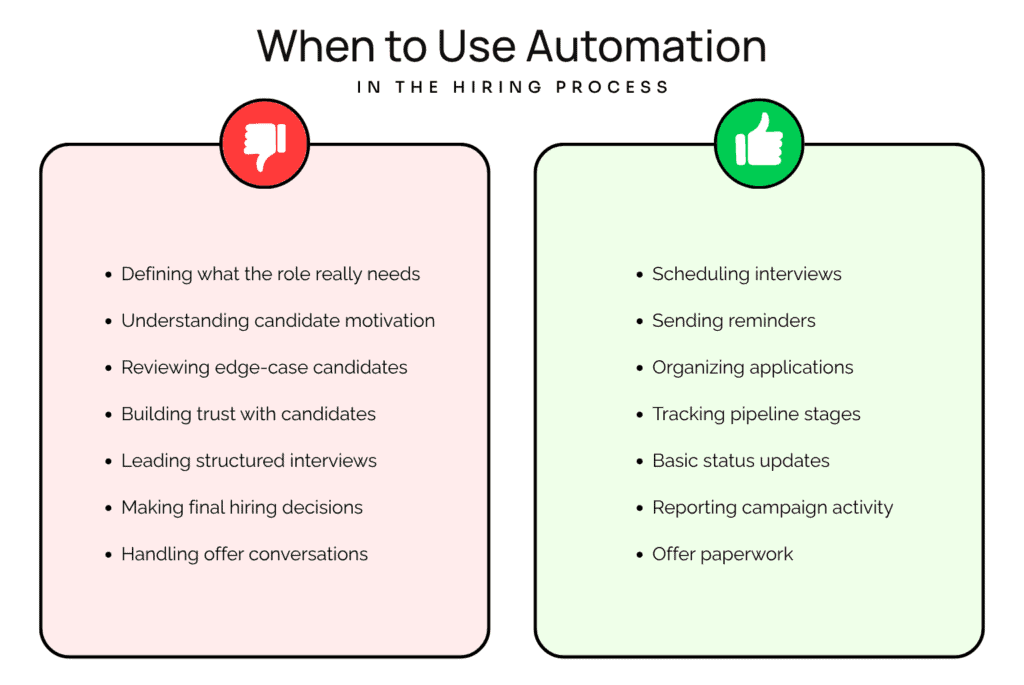
Automation is strongest when it removes bottlenecks resulting from repetitive work. It can help employers distribute job ads, organize applications, schedule interviews, send reminders, track candidate stages, document screening activity, maintain basic communication, and report on campaign performance.
But when it comes to judgment, trust, and accountability, automation may cause more problems than it fixes.
People should still own role definition, screening context, candidate conversations, structured interviews, final decisions, offer discussions, and the onboarding handoff. Those are the steps in the process where employers learn what the resume doesn’t show and candidates decide whether the opportunity is worth pursuing.
You don’t have to choose between people and technology. The most successful hiring processes often use automation to keep the process moving and people to protect the moments where the decision actually gets better.
RPO: Hands Off Hiring with a Human Touch
For employers that need a better candidate flow but don’t want to lose the human side of the process, WorkRocket’s recruitment process outsourcing support can help with front-end recruiting activity such as recruitment marketing, sourcing, screening, campaign management, and hiring-process visibility.
Our Gibbs Die Casting case study is a good example of the impact a partner like WorkRocket can have on the success of an organization’s hiring process. In this case study, we handled advertising, sourcing, and phone screening for industrial maintenance mechanic campaigns, helping generate qualified applicants while saving internal hiring time.
For more information on our services, reach out to our team to see how we may be able to help you improve your hiring process while reducing the load on your team.
