
Hard-to-fill roles don’t stay open because nobody hit “post” on the job ad.
They stay open because you’re recruiting in a market where there are simply too many openings chasing too few people who are actually available.
And the people who can do the work usually aren’t applying. They’re working. So internal teams end up trying to run two jobs at once: keep the hiring machine moving for everything else, while also doing true outbound recruiting for scarce talent. That’s where searches drag on for weeks, the candidate profile changes throughout the process, and leadership gets a report full of activity with no hire. It’s exhausting.
The good news is there are still options that will help you improve your chances of hiring these hard-to-fill roles. In this article, we’ll discuss some of the issues that cause searches to be so difficult, talk about where the money leaks when roles sit open, and discuss how recruitment process outsourcing can fix the underlying constraints.
Table of Contents
Requirements That Shrink the Talent Pool
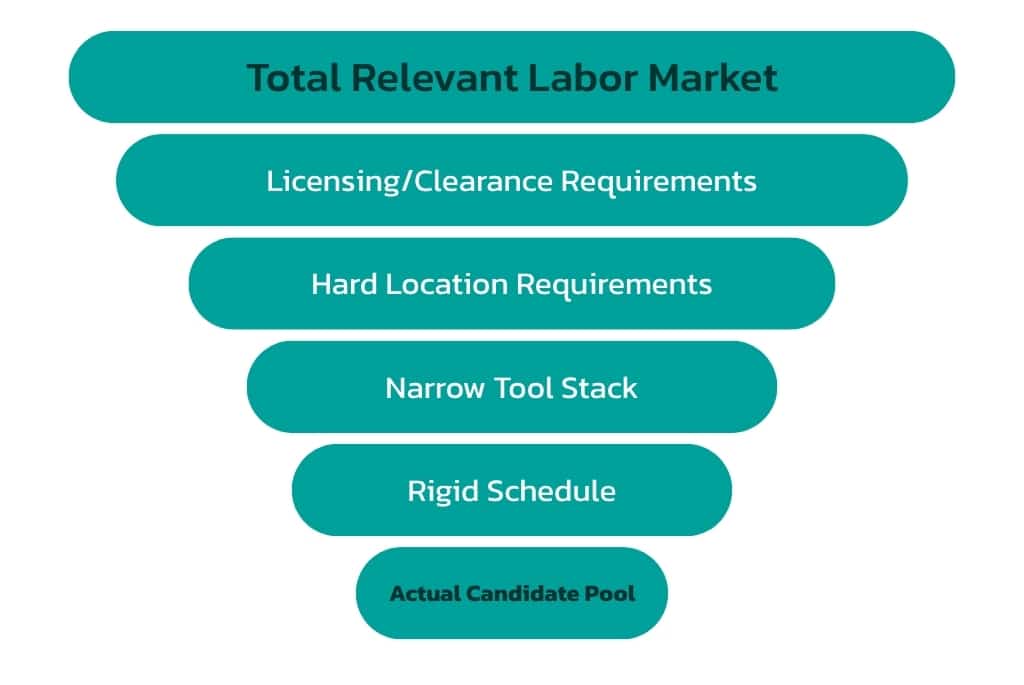
A role becomes hard-to-fill when the relevant labor market can’t produce enough qualified candidates at the offered pay, location, schedule, and requirements. Some of these issues may be a result of the labor market but often, the requirements that are being set are the factors that are limiting the search. Here are some common restraints we see that limit the talent pool:
- Licensing or clearance requirements remove otherwise strong candidates
- A rigid schedule filters out parents, caregivers, and commuters
- A narrow tool stack excludes adjacent talent that could ramp quickly
- A hard location requirement reduces the pool to a commute radius
Why Internal Teams Stall on Hard-To-Fill Roles
Requisition Load Forces Transaction Work
When recruiters manage many open roles, they spend time on coordination and triage: scheduling, status meetings, resume review, interview logistics, offer paperwork. That work keeps the machine running, but it leaves little capacity for the part that moves hard-to-fill roles: targeted outbound sourcing and follow-up.
Here is what usually happens in practice:
- A recruiter runs a quick search, sends a batch of outreach, and waits
- Responses trickle in slowly because the best candidates already have jobs
- The hiring manager sees a thin slate and assumes “recruiting is not working”
- The recruiter pivots to easier roles to protect throughput metrics
- The hard role ages, and the search loses urgency
Intake Drift Turns the Search into a Moving Target
Hard-to-fill roles cannot tolerate vague intake. If the hiring manager and talent acquisition team don’t define the profile early, the search becomes a series of resets.
Common drift patterns:
- “Must-have” skills expand after the first round of interviews
- The compensation band becomes negotiable only after top candidates reject
- Stakeholders evaluate different traits because nobody agreed on a scorecard
Structured interviews help reduce these changes. A meta-analysis published in the Journal of Applied Psychology found structured interviews predict job performance better than unstructured interviews. Better prediction matters, but so does speed. Structured evaluation shortens debate and reduces late-stage reversals.
The EEOC’s Uniform Guidelines on Employee Selection Procedures also emphasize consistent selection procedures and documentation, which becomes more important when multiple interviewers participate and decisions carry legal risk.
Hiring Teams Often Mistake Activity for Progress
Many organizations track how many candidates enter the funnel. Fewer track where the funnel breaks.
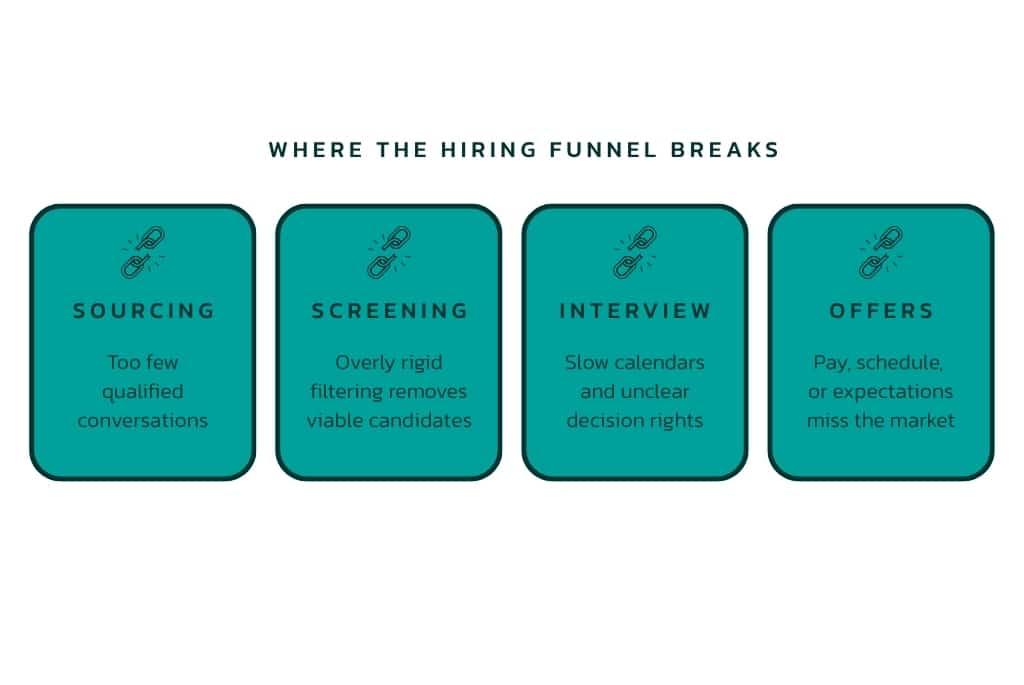
Hard-to-fill roles often fail in one of four places:
- Sourcing produces too few qualified conversations
- Screening filters out candidates who could succeed with minor trade-offs
- Interviews run slowly because calendars and decision rights stay unclear
- Offers fail because pay, schedule, or role expectations do not match the market
Without clean funnel data, hiring meetings turn into opinion fights. That costs time and credibility.
The Financial Impact of Leaving Roles Open
Vacancy cost rarely appears as a single expense. It leaks through operations.
Where Vacancy Cost Shows Up
An open role often triggers predictable behaviors:
- Overtime to cover shifts or service levels
- Supervisors stepping into frontline work instead of managing performance
- Deferred maintenance, training, or quality checks
- Slower sales cycles because coverage drops
- Delayed projects because dependencies remain unstaffed
Finance teams often miss these costs because they spread across cost centers.
SHRM provides a vacancy rate and cost calculation tool that helps quantify the impact of open roles. The exact figure will vary by business, but the exercise forces leaders to price the consequence of waiting.
Burnout Creates Second-Order Turnover
Vacancies load work onto the people who remain. That pressure often leads to disengagement and exits, especially in roles where the work cannot pause.
Gallup’s burnout research links sustained workload and lack of support to lower engagement and higher risk outcomes for teams. Employees who frequently experience burnout are 63% more likely to take a sick day and 2.6 times as likely to be actively seeking a different job.
One vacancy can create another if leaders let the role stay open.
Turnover Drivers Often Connect Back to Hiring Discipline
The Work Institute’s 2024 Retention Report summarizes common reasons for voluntary turnover using exit interview data, including job-related and management-related factors.
Hard-to-fill roles magnify this risk. If the organization hires quickly without making a strategic decision, it may reopen the same role within a year. If it hires slowly, it taxes the team while it waits. Either way, weak processes cost money.
How To Recruit for Hard-To-Fill Roles with Intention
Hard-to-fill recruiting works best when leaders treat it as a constrained market problem, not an ad posting problem.
Set The Market Frame Before the Search Starts
Before sourcing begins, hiring leaders should align on:
- The true must-haves that predict performance
- Acceptable substitutes and adjacent backgrounds
- Compensation range that clears the market
- Location and schedule flexibility, if any
- Decision authority for trade-offs
A search runs faster when the hiring team agrees up front on what it will compromise.
Build A Scorecard and Calibrate Interviewers Early
A scorecard should be tied to outcomes. What does success look like after six months? What mistakes break performance? That clarity helps interviewers evaluate the same signals.
Structured interviews improve predictive validity and reduce interview variation. They also reduce time lost to rehashing candidate impressions after the fact.
Separate Outbound Sourcing from Coordination Work
Outbound sourcing requires a different rhythm: targeted identification, message testing, follow-up, and relationship tracking. It does not fit neatly between scheduling and weekly reporting.
Hard-to-fill roles often need sustained outreach over weeks, not a single burst.
Where Recruitment Process Outsourcing Changes the Operating Model
Recruitment process outsourcing works when it fixes the specific constraints that keep internal teams stuck.
RPO Adds Dedicated Sourcing Capacity
A strong RPO provider typically assigns sourcing specialists whose primary job is outbound pipeline creation. That removes the trade-off internal recruiters face between coordination and outreach.
RPO Tightens Intake and Decision Cadence
Many successful RPO engagements put structure around the beginning of a search:
- Intake that forces agreement on must-haves and trade-offs
- A scorecard that aligns interviewers
- Weekly funnel reviews that isolate the breakdown
- Time-to-slate expectations that keep the search moving
This doesn’t remove leadership responsibility. Hiring managers still must interview on time, decide quickly, and support realistic pay and flexibility decisions.
RPO Makes Funnel Problems Visible
Many internal teams end up blaming the hiring market for problems that are actually a result of funnel issues within their process. The problem is that most internal teams lack the time and resources needed to find these issues and address them.
These issues typically appear in a couple of places within the hiring process. If the offers fail on acceptance, your compensation or schedule is likely the driving issue. If candidates withdraw mid-process, decision speed likely drives the issue. If qualified conversations stay low, sourcing capacity and targeting likely drive the issue.
If you’re relying solely on your internal team, it’s up to them to find these issues through calls with candidates and to adjust their process to fix the issues. This requires your team to expand its bandwidth and can create more problems if your hiring process is already too slow.
RPO expands that bandwidth without affecting your team. You don’t need to waste your internal team’s time making calls to figure out the issues in the process. RPO providers like WorkRocket have the extra time to call more candidates, discuss expectations, compare these expectations across the candidate pool, and determine potential weak points in the process. Once the issues have been defined, the provider is able to offer advice or take action to improve the hiring process.
Things that would’ve become a burden to your hiring team are now easily addressed by your RPO provider without causing any delays or issues in the hiring process.
Conclusion
Hard-to-fill roles expose the same set of problems again and again: shallow sourcing capacity, loose intake, inconsistent interviews, and slow decision-making in a tight labor market.
Vacancies don’t stay contained. They spread into overtime, burnout, missed deadlines, and avoidable turnover.
Organizations that want better results should price the cost of waiting, define trade-offs early, and run the search with structured evaluation and consistent cadence. When internal capacity cannot support that level of effort, recruitment process outsourcing becomes a practical fix.
A sensible next step is to pick one chronically open role, calculate vacancy impact using SHRM’s tool, and evaluate whether an RPO provider such as WorkRocket can shorten time-to-slate and improve offer acceptance through tighter targeting and faster decisions.
If you’d like to learn more about the RPO services offered at WorkRocket, reach out to our team to discuss the benefits we can offer your hiring team.
