
Phone screening has quietly regained importance in recruitment strategy. Not as a legacy step inherited from pre-video hiring, but as a deliberate control point in a hiring process that has become faster, noisier, and more expensive to get wrong.
Hiring managers face compressed timelines, inflated applicant volume, and rising early turnover. Recruiters face pressure to move candidates quickly without sacrificing quality. In that environment, the phone screen serves a different purpose than it did five years ago. It filters risk, not just résumés.
This article breaks down how phone screening functions as a modern recruitment lever, where it adds measurable value, and how teams are misusing it in 2026.
Table of Contents
What Phone Screening Accomplishes in a Modern Recruitment Strategy
At its best, phone screening creates asymmetry. It allows a hiring team to gather high-signal information before committing time, internal attention, and candidate goodwill to later-stage interviews.
A résumé confirms eligibility. A phone screen tests alignment.
Within ten to fifteen minutes, a skilled screener can surface communication clarity, motivation credibility, compensation alignment, and role understanding. None of those are reliably visible on paper or through asynchronous screening tools.
This matters because hiring inefficiencies compound early. The Society for Human Resource Management estimates the average cost per hire in the United States at roughly $4,683, with significantly higher downstream costs when a hire fails inside the first year.
Phone screening exists to prevent wasted motion later in the funnel, where costs rise and decisions become harder to reverse.
Where Phone Screening Fits in a High-Performing Recruitment Funnel
Phone screening works best as a gate, not a hurdle. When it becomes an obstacle course, candidate experience degrades and decision quality suffers.
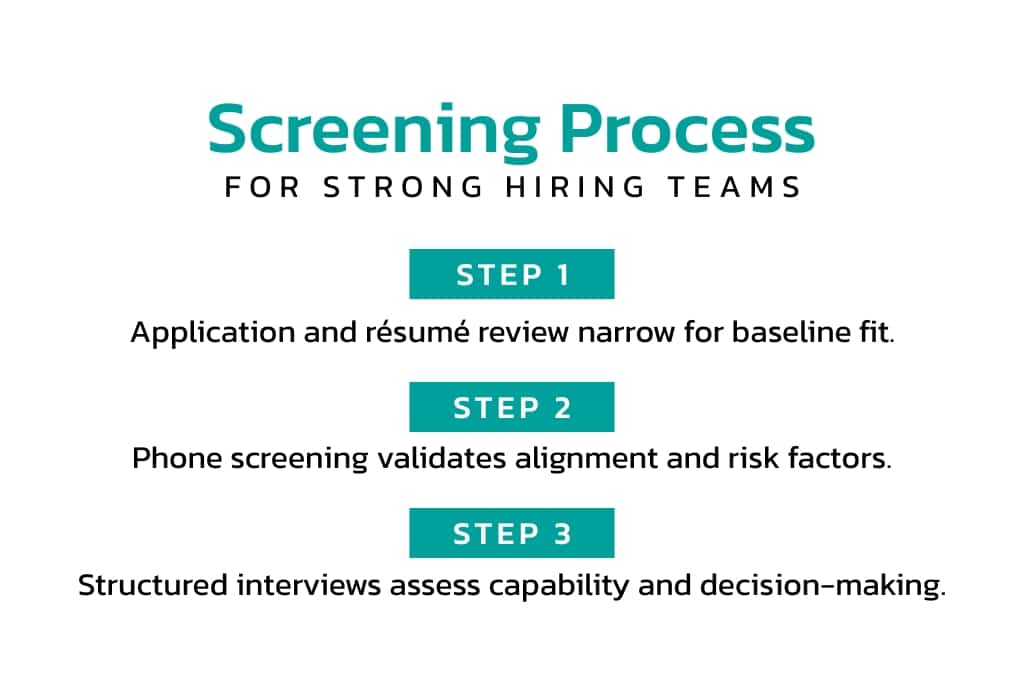
A consistent pattern emerges across strong hiring teams:
- Application and résumé review narrow for baseline fit.
- Phone screening validates alignment and risk factors.
- Structured interviews assess capability and decision-making.
The phone screen should never attempt to replace a structured interview. Research published in Harvard Business Review shows that unstructured interviews perform poorly at predicting job performance, while structured formats dramatically improve validity.
Phone screening works precisely because it avoids overreaching. It answers whether a candidate should advance, not whether they should be hired.
The Real Signals Phone Screening Reveals That Other Steps Miss
Most articles frame phone screening as a time saver. That undersells its value.
The stronger benefit lies in early signal extraction.
Communication Under Constraint
Phone screens remove visual cues. That limitation becomes an advantage. Candidates must explain experience, scope, and outcomes clearly without slides, notes, or body language to compensate.
Hiring managers consistently report that candidates who struggle to articulate impact verbally tend to struggle later in cross-functional roles.
Motivation Credibility
Generic interest sounds rehearsed. Specific interest does not.
Candidates who understand the role, the business, and why the move makes sense for them reveal that quickly when asked open-ended questions. Those who applied broadly often cannot.
Compensation and Logistics Alignment
Misalignment here kills deals late and quietly. A brief, direct compensation discussion during a phone screen prevents weeks of wasted process and preserves candidate trust.
Phone Screening vs Automated Screening Tools
Automated screening tools promise efficiency. In practice, they often optimize for compliance rather than judgment.
Keyword filters and knock-out questions remove obvious mismatches. They struggle with context, transferable skills, and non-linear career paths.
Phone screening reintroduces discretion at the right moment. It allows recruiters to override rigid filters when experience warrants it and to disqualify candidates whose résumés look strong but unravel under basic questioning.
In hybrid recruitment strategies, automation narrows the pool. Phone screening decides who deserves attention.
Why Phone Screening Impacts Retention, Not Just Time to Hire
Early turnover remains one of the most expensive hiring failures. The U.S. Bureau of Labor Statistics shows that median employee tenure remains under five years, with significantly shorter tenure among early-career and frontline roles.
Phone screening reduces early exits by addressing expectation gaps before an offer exists.
Candidates who misunderstand reporting lines, workload intensity, or growth trajectory often accept roles they should have declined. A well-run phone screen surfaces those mismatches early, when walking away feels low risk on both sides.
In practice, this often leads to fewer offers accepted but higher offer stick rates.
Common Phone Screening Mistakes That Undermine Hiring Quality
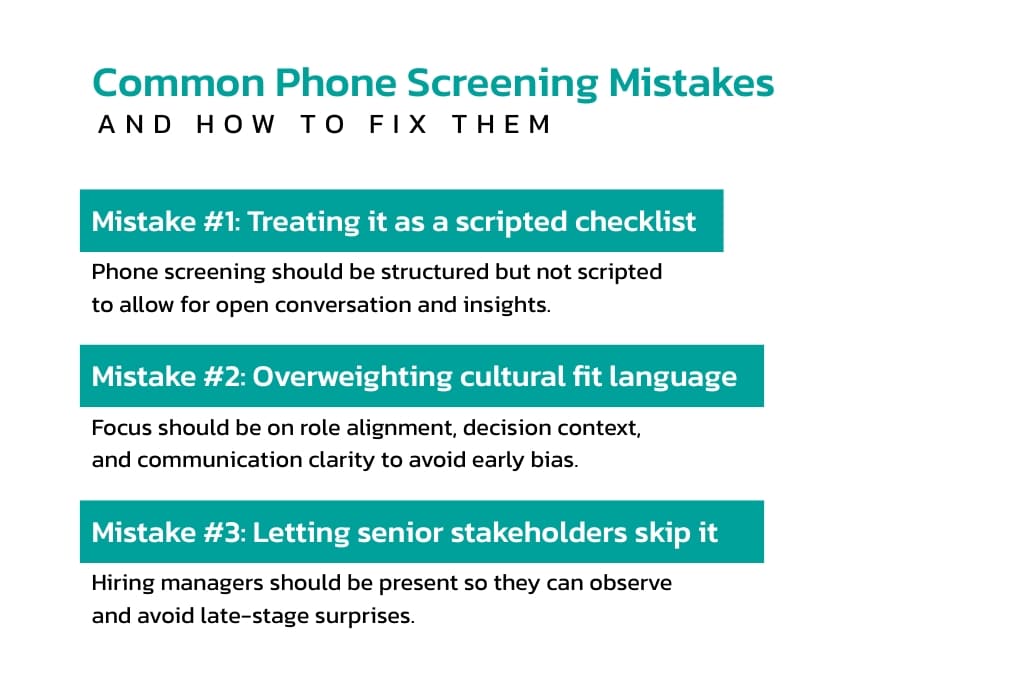
Treating It as a Scripted Checklist
Rigid scripts flatten conversation and suppress useful signals. Effective phone screens follow a structure, not a script. The difference is subtle but critical.
Overweighting Cultural Fit Language
Vague questions about “fit” invite bias and produce little insight. Phone screens should focus on role alignment, decision context, and communication clarity. Culture reveals itself later.
Letting Senior Stakeholders Skip It
When hiring managers bypass phone screening entirely, recruiters absorb all early risk. That separation often leads to late-stage surprises and stalled offers.
Insights for Better Phone Screening Results
Shorter Screens Produce Better Data
Long phone screens encourage overconfidence. Teams that cap phone screens at fifteen minutes report clearer go-forward decisions and fewer false positives. Constraint sharpens judgment.
Phone Screening Is a Training Tool for Recruiters
Recorded and reviewed phone screens accelerate recruiter calibration faster than résumé reviews or interview shadowing. Strong organizations treat phone screening as a performance asset, not administrative labor.
These practices rarely appear in surface-level hiring advice but correlate strongly with consistent hiring outcomes.
How Phone Screening Supports a Scalable Recruitment Strategy
As hiring volume increases, inconsistency becomes the hidden risk. Phone screening creates a repeatable checkpoint that scales without diluting standards.
It also protects candidate experience. Rejecting a candidate after a brief conversation feels more respectful than ghosting or late-stage rejection after multiple interviews.
That reputational effect compounds, especially in competitive labor markets.
Phone Screening and the Role of WorkRocket
WorkRocket supports hiring teams that want speed without sacrificing judgment. Phone screening remains a core component of that approach because it balances efficiency with human evaluation.
The goal isn’t more steps. It’s fewer bad ones.
If your team is struggling to handle the phone screening process alone, WorkRocket is here to help. We can take over the phone screening process for your team so they can save time and focus on the things that matter the most.
To learn more about our phone screening and other services we offer, contact one of our team members. We’re happy to discuss the benefits we can offer your business through our RPO services.
Conclusion
Phone screening works when teams use it intentionally. Not as a legacy habit. Not as a box to check. As a decision filter that reduces downstream cost, improves alignment, and protects hiring velocity.
Recruitment strategies that abandon phone screening often replace it with noise. Strategies that refine it gain leverage.
For teams refining their hiring process in 2026, the question is not whether to phone screen. It is whether the screen is designed to surface the right risks early.
