
Have you ever wondered whether your recruitment team is truly performing at its best? Or if hidden inefficiencies are slowing down your organization’s growth?
If you have, you’re in the right place. In this article, we talk about the role of recruitment audits in assessing your team’s performance and give you easy to follow steps that you can take to begin your own audit.
Our team has been using these audit strategies for years to help businesses like you improve their recruitment team performance.
Ready? Let’s dive in!
Why a Recruitment Audit Matters More Than Ever
Most companies rely heavily on hiring to stay competitive, yet few regularly evaluate their talent acquisition efforts.
Today’s competitive labor market is defined by talent shortages, rising costs, and shifting candidate expectations. Auditing your recruitment process is no longer optional; it’s essential.
Hiring inefficiencies cause financial drains.
Consider these data points:
- The U.S. Bureau of Labor Statistics reports that the average job vacancy costs employers roughly $98 per day in lost productivity. Over just one month, that’s more than $2,000 lost per unfilled role.
- SHRM’s national research shows the average cost-per-hire is $5,475, with some roles costing significantly more depending on level and industry.
With numbers like these, even small inefficiencies in your recruitment team can create major long-term costs. A recruitment audit helps uncover those inefficiencies before they grow.
Below, we’ll help walk you through the steps needed to audit your recruitment team.
Step 1: Review Recruitment Performance Metrics
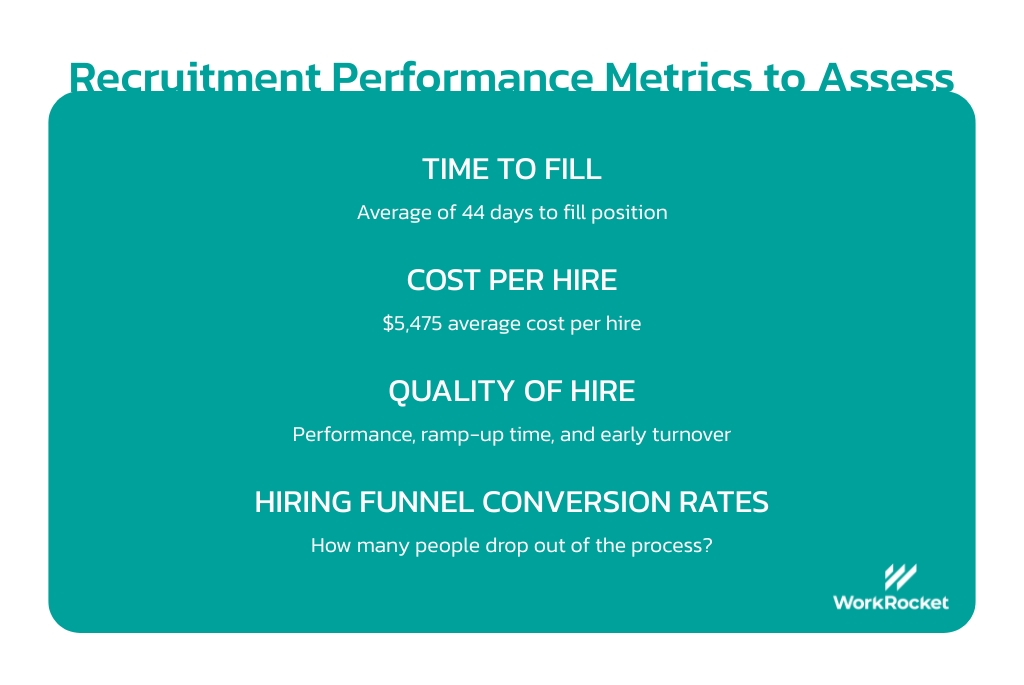
The first step in any recruitment audit is to get clear on the numbers. Data reveals bottlenecks faster than any meeting or anecdotal feedback.
Look carefully at your:
Time-to-fill
One study reports a national average of 44 days to fill a role. If your positions consistently take longer, it may signal slow workflows, lack of sourcing pipelines, or inefficient screening processes.
Cost-per-hire
Benchmark your spending against SHRM’s national $5,475 figure. Costs that trend far above that number often indicate sourcing inefficiencies or workflow duplication.
Quality-of-hire indicators
Performance, ramp-up time, and early turnover all signal whether your recruitment team is bringing in the right talent.
Hiring funnel conversion rates
If many candidates drop out at the same stage, that piece of the process needs attention.
Step 2: Evaluate Candidate Experience
Candidate experience plays a direct role in hiring outcomes and reputation.
52% of job seekers said they declined a job offer because of poor experience with the hiring process (e.g. slow timelines, bad communication, and confusing application processes).
This statistic reinforces why your recruitment team’s communication style, interview pace, and application process matter more than ever.
Questions worth exploring during your recruitment audit include:
- Are candidates receiving updates in a timely manner?
- Are interview steps consistent and efficient?
- Is the application process user-friendly across devices?
Even minor improvements can meaningfully increase acceptance rates and reduce talent drop-offs.
Step 3: Analyze Internal Workflows and Technology
Your recruitment team is only as efficient as its systems. Slow hiring cycles are often symptoms of workflow gaps, outdated tools, or underutilized ATS features.
According to McKinsey, companies see up to a 30% increase in team productivity when they use digital collaboration tools effectively.
During your recruitment audit, examine:
- How well recruiters and hiring managers collaborate
- Whether job approvals, screenings, and interviews follow a consistent sequence
- How effectively your applicant tracking system supports sourcing and communications
Often, the problem isn’t a lack of effort; it’s a misalignment in process steps or tools being used inconsistently.
Step 4: Assess Hiring Manager Collaboration
Hiring managers play a critical role in recruitment success. If they’re slow to review resumes, unclear on job expectations, or inconsistent in interview evaluations, hiring stalls quickly.
Your audit should review:
- Clarity of job requirements
- Consistency of interview expectations
- Responsiveness to recruiter communication
- Alignment between hiring managers and the recruitment team
Breakdowns in these areas often create avoidable delays, mis-hires, or weak candidate experiences.
Step 5: Identify Skill Gaps in Your Recruitment Team
A recruitment audit should include an honest review of recruiter capabilities. Even experienced teams may need new skills as hiring expectations evolve.
This is especially important considering Gartner found that only about 20% of employees have the skills needed for both their current role and their future career.
Recruiters today must be strong in:
- Talent sourcing
- Employer branding
- Interviewing and evaluation
- Data literacy
- Tech-enabled recruiting practices
If skill gaps exist, training or process redesign may be needed to improve the quality of your recruitment team.
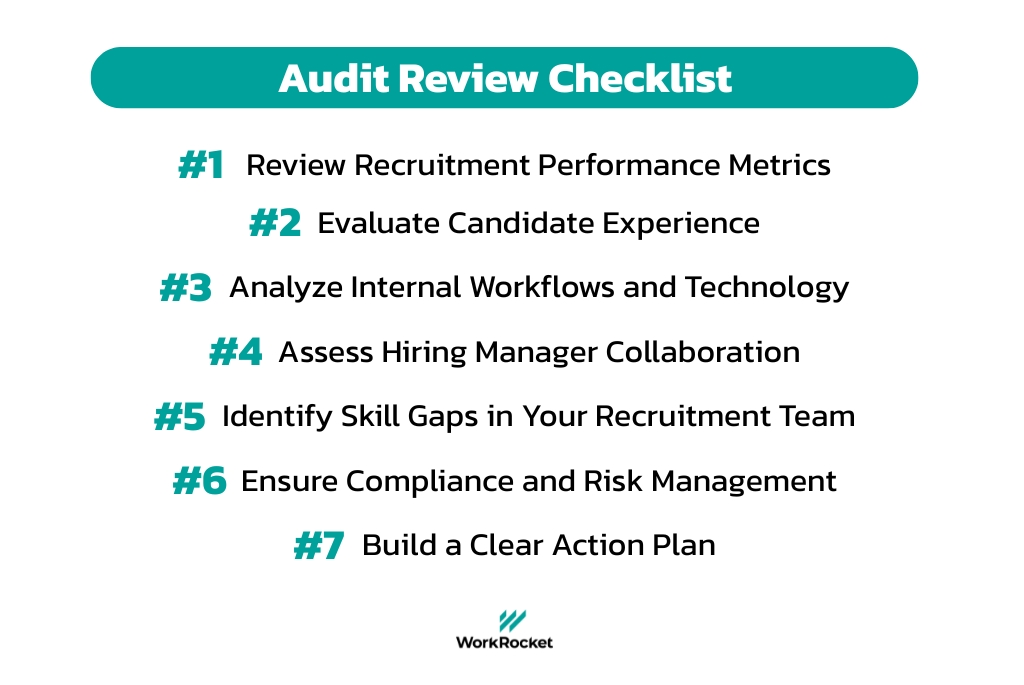
Step 6: Ensure Compliance and Risk Management
A recruitment audit isn’t complete without reviewing:
- Job posting accuracy
- Interview documentation
- Proper recordkeeping practices
Inconsistencies in documentation or interview procedures can create legal exposure, often without the company realizing it.
Step 7: Build a Clear Action Plan
An audit is only valuable if it leads to improvements. Convert findings into a structured roadmap that outlines:
- The most urgent areas to fix
- Which processes need redesign
- What training will help elevate recruiter performance
- How hiring managers should adjust their involvement
- Which tools need enhancement or replacement
Most organizations should aim for a 90-day and 180-day implementation plan to ensure momentum.
Takeaway: A Recruitment Audit Strengthens Your Entire Hiring Function
A high-performing recruitment team is one of the most powerful strategic assets a company can have. But even the best teams need regular evaluation to stay aligned with business goals and market trends.
A detailed recruitment audit provides the visibility and direction needed to improve efficiency, strengthen collaboration, and ultimately bring better talent into your organization faster.
WorkRocket partners with companies to uncover these insights and build stronger, more predictable hiring systems that support long-term growth. If you’re looking for a new type of hiring system, talk to WorkRocket about their RPO services and see how they can help improve your recruitment team!
