
Have you ever looked at recruitment fees on a proposal and wondered, “Why does hiring one person cost this much?” You’re not alone. For many employers, especially growing companies trying to scale quickly, recruitment costs feel mysterious.
Once you understand how those fees work, the value behind them becomes clearer, and the differences between recruitment partners stand out in powerful ways.
In this article, we’ll break down how typical recruitment fees are structured, why the traditional model doesn’t always favor employers, and how WorkRocket has built a better, more predictable, and more productive alternative.
Table of Contents
What Are Recruitment Fees?
Recruitment fees are the charges a hiring agency collects for sourcing, screening, and referring candidates who ultimately get hired. That fee typically covers the entire process, including:
- Writing and posting job ads
- Sourcing candidates from databases and networks
- Screening resumés and conducting phone interviews
- Presenting top candidates for final interviews
But while the operations behind the scenes are fairly standard among agencies, the cost structure widely varies.
Hiring costs in general are steep. According to the Society for Human Resource Management (SHRM), the average cost per hire in the U.S. is $4,700, and internal costs, such as staff time, are often three to four times the salary of the role when combined with training and productivity loss during onboarding. This means that the placement fee is only part of what companies truly spend when filling a role.
All of this has pushed many employers to look for more clarity, more predictability, and more value.
How Do Traditional Recruitment Fees Work?
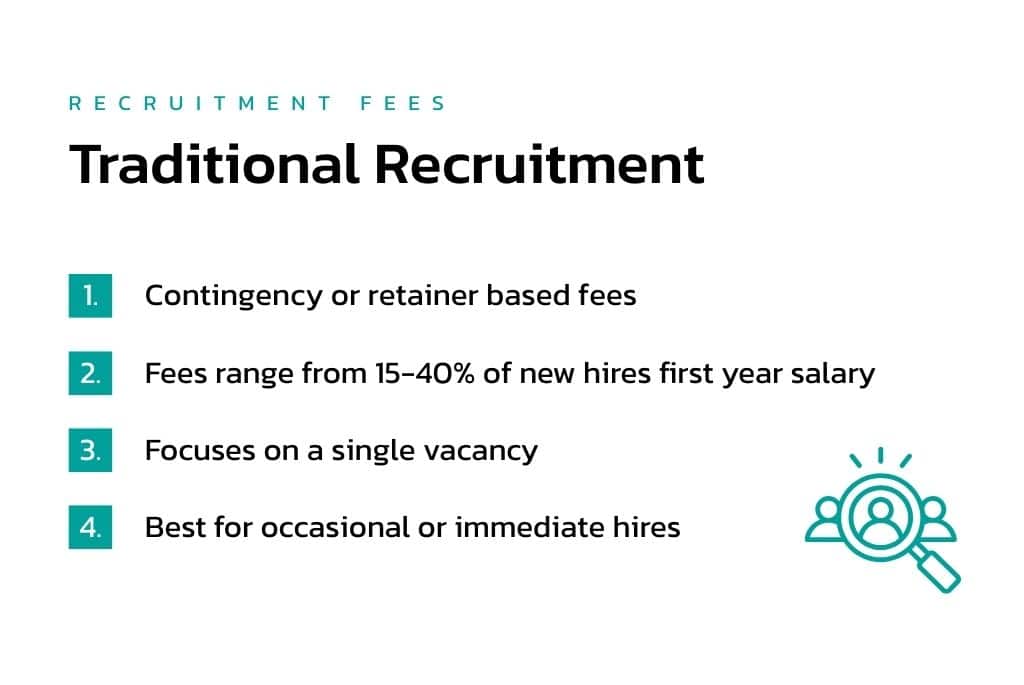
Traditional recruitment fees are commonly structured around a contingency-based or percentage-of-salary model, making them popular for companies seeking quick, individual hires without long-term commitments.
In a typical contingency model, employers pay only when a candidate is successfully placed, with fees ranging from 15% to 40% of the new hire’s first-year salary, depending on the role’s level, urgency, and industry. Some agencies may charge higher percentages for executive placements or hard-to-fill positions due to the added time and specialized sourcing required.
These fees generally include services such as job advertising, resume sourcing, candidate screening, initial interviews, and shortlisting. However, traditional recruitment often focuses on filling a single vacancy, so it may not provide broader support like employer branding, recruitment analytics, talent pipelines, or workforce planning.
Many agencies also offer exclusive or retained search options, where companies pay an upfront fee or retainer to secure dedicated recruiter time, typically used for senior or niche roles.
While traditional recruitment fees can be cost-effective for occasional or immediate hires, they can become expensive for ongoing or high-volume recruitment needs.
How Do Recruitment Process Outsourcing (RPO) Fees Work?
Recruitment Process Outsourcing (RPO) service fees are structured to give businesses flexible, scalable support while aligning costs with hiring goals. Understanding these fee models is essential for budgeting and maximizing ROI. Most RPO providers use one of three primary pricing models: management fees, cost-per-hire fees, or hybrid structures.
Management-fee models involve a fixed monthly or annual rate that covers the provider’s ongoing management of the recruitment function. This fee typically includes recruiter salaries, technology, reporting, and day-to-day operations. It’s ideal for companies with steady hiring needs because it provides predictable, stable pricing.
Cost-per-hire models charge a set fee for each successful placement. This approach works best for organizations with fluctuating or project-based hiring demands. The fee usually includes sourcing, screening, interviewing support, and onboarding coordination. Cost-per-hire offers clear visibility into what each new hire costs, making it easier to evaluate performance and budget accurately.
Hybrid pricing models combine both approaches, often with a lower monthly management fee paired with a reduced cost-per-hire. This model is especially useful when businesses want both predictable support and performance-driven incentives. It ensures the RPO provider has a baseline to cover ongoing operations while staying motivated to deliver high-quality hires efficiently.
Some RPO providers also build fees around additional elements such as technology usage, employer branding support, candidate experience tools, or recruitment marketing campaigns. These add-ons can impact overall pricing but often improve hiring outcomes and long-term retention.
By understanding how RPO service fees work and the value built into each model, organizations can choose a structure that aligns with their hiring volume, budget, and long-term talent strategy, ultimately optimizing costs, improving candidate quality, and strengthening overall recruitment performance.
How WorkRocket’s RPO Service Fees Are Different
WorkRocket doesn’t take the traditional percentage fee or any of the standard RPO fee paths. Instead, the company designed a flat fee RPO approach focused on flexibility, transparency, and true partnership with employers. WorkRocket charges for the work of recruitment marketing, not the hire itself.
In WorkRocket’s model, a flat fee is paid up front and the fee is determined by the RPO package you select. WorkRocket does all of the work to market your recruitment efforts and passes the applicants off to you after it’s been determined that they would be a good fit for the role.
Unlike a traditional recruiter fee structure, you aren’t paying for the hire; you’re paying for the advertising of the open role. This means that we do not guarantee a hire from every campaign but you could potentially hire multiple candidates from a single campaign without any extra cost to you. WorkRocket will do all of the legwork to make sure you have candidates to choose from, but it’s up to you to determine whether or not you hire one of them.
For more detailed information about the RPO services we offer, please reach out to our team to discuss further.
Benefits of WorkRocket’s Flat Fee RPO Services
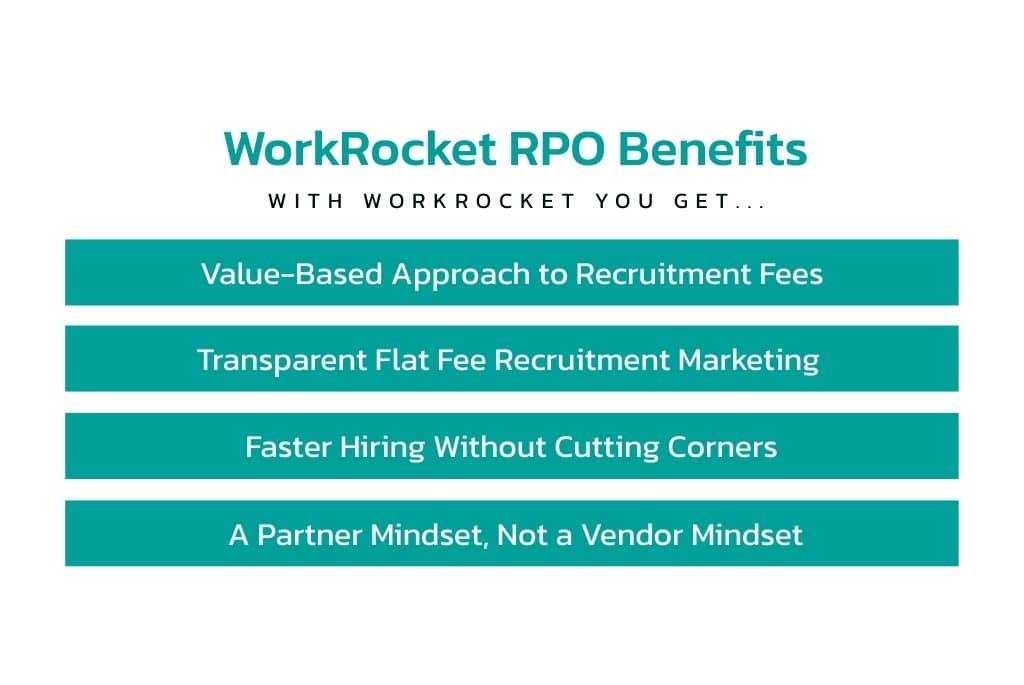
A Smarter, Value-Based Approach to Recruitment Fees
Instead of charging based on salary, WorkRocket structures its recruitment fees based on:
- The complexity of the role
- The volume of roles being filled
- The level of ongoing support the employer needs
That means a highly skilled hire doesn’t automatically come with a disproportionately high fee just because the salary is higher. WorkRocket charges for the work, not the salary.
This structure is especially attractive for companies hiring technical, manufacturing, and trade-skill professionals; positions in which market expertise often matters more than compensation level.
Transparent Flat Fee Recruitment Marketing
WorkRocket offers flat fee recruitment marketing, but the difference is that we provide a variety of flexible options to let you decide how involved you are in your recruitment marketing.
With a flat fee approach, employers know their exact spend upfront, which helps tremendously with budgeting and long-term workforce planning.
Our flexible options allow your company to customize your recruitment marketing plan to meet the exact needs of your company, regardless of the position you’re trying to fill. With each option, you know the price of the service up front and can compare the cost of different strategies. We give you the freedom to choose the right service for your needs.
Faster Hiring Without Cutting Corners
Time-to-hire is one of the biggest hidden expenses in talent acquisition. According to research from SHRM, unfilled revenue generating roles cost companies between $7,000 and $10,000 per month in productivity loss depending on position level.
The longer a role sits vacant, the more money a company loses; no matter how much it “saves” by trying to do everything internally.
WorkRocket minimizes these losses by:
- Maintaining large talent networks
- Leveraging specialized industry knowledge
- Running efficient sourcing and screening workflows
This combination routinely cuts hiring timelines significantly. Faster hiring means lower real-world costs.
A Partner Mindset, Not a Vendor Mindset
Most recruitment agencies operate on volume: fill the role, collect the fee, move on. WorkRocket takes a different approach by acting as a strategic extension of your hiring team.
That includes understanding:
- Your culture
- Your workforce needs
- Your long-term goals
- The behavioral fit that makes a candidate successful
This alignment pays off. Studies from the U.S. Department of Labor estimate that a poor hiring decision can cost a company up to 30% of the employee’s first-year earnings when factoring in lost productivity, rehiring expenses, and overall disruption to the business. Better alignment means fewer mis-hires and greater ROI on every recruitment fee you pay.
WorkRocket: A Better Way to Hire
Recruitment fees don’t have to feel confusing or unpredictable. Once you understand how traditional fee structures work, it becomes much easier to see where money is wasted and where true value comes from.
WorkRocket’s difference lies in its commitment to:
- Flexible options
- Flat fee, transparent pricing
- Faster, higher-quality hiring
- Long-term partnership with clients
Whether you’re trying to fill one critical role or build an entire team, WorkRocket brings a more strategic, cost-effective, and human-centered approach to recruitment.
To learn more about the details of our RPO services, get in touch with our team!
