
You’ve signed the RPO contract. The vendor shows up ready to deliver the pipeline but your internal recruiters start moving slower, asking more questions, and suddenly every candidate has a “culture concern.”
Here’s what’s actually happening: you’ve handed someone else the steering wheel but left your team responsible when the car crashes.
Internal recruiters resist RPO when they lose control over decisions but still catch blame for bad outcomes. If you haven’t redesigned their role before launching the RPO campaign, you’re creating a turf war, not a partnership.
Table of Contents
The Real Problem Is Role Collision
Most RPO implementations fail because nobody told your internal team how they’re supposed to work with this new partner who just took over half their job.
Your recruiters have been managing intake, setting priorities and deciding which hiring manager gets attention first. Now there’s someone else making those calls, and the org chart doesn’t explain who wins when there’s a conflict.
Business owners underestimate how much hiring runs on informal authority. Your internal team knows which manager will ghost candidates, which roles need creative sourcing and when to push back on a ridiculous job description. That intelligence doesn’t live in your applicant tracking system. RPO providers don’t get it on day one.
When you don’t explicitly redesign how decisions get made, people fill the gaps themselves. Usually by protecting what they’ve always done.
Why Internal Teams Push Back
They Lose Control Over What Actually Moves
Internal recruiters typically decide which requisitions to launch first, which ones need rescoping and which hiring managers need more clarity before anyone touches LinkedIn. RPO introduces a second decision-maker and suddenly those judgment calls aren’t theirs anymore.
When the RPO team starts running roles without internal approval, recruiters can’t manage hiring manager expectations or slow down half-baked job specs. Your recruiter who used to tell the VP of Sales “we need two more weeks to write this properly” now watches the RPO team launch it anyway.
They’re Afraid of Becoming Admin Support
Nobody wants to go from recruiter to scheduler. But that’s the fear: they’ll coordinate interviews, update spreadsheets, answer Slack messages while the RPO folks do actual recruiting. This can make teams feel like they’ve been replaced.
This pattern shows up everywhere in professional services outsourcing. Research from MIT Sloan Management Review documents how organizations bringing in external capacity without redefining internal roles create situations where employees feel demoted even when their titles stay the same.
Internal resistance to outsourcing reflects real psychological responses to perceived economic threat. Research in organizational psychology finds that outsourcing activates deep threat perceptions about job loss, loss of predictability, and reduced control over one’s work environment, even among employees who aren’t directly displaced by outsourcing decisions. These cognitive and affective responses help explain why a significant segment of workers reacts negatively to outsourcing as part of broader workforce strategy shifts.
They’re Accountable for Outcomes They Don’t Control
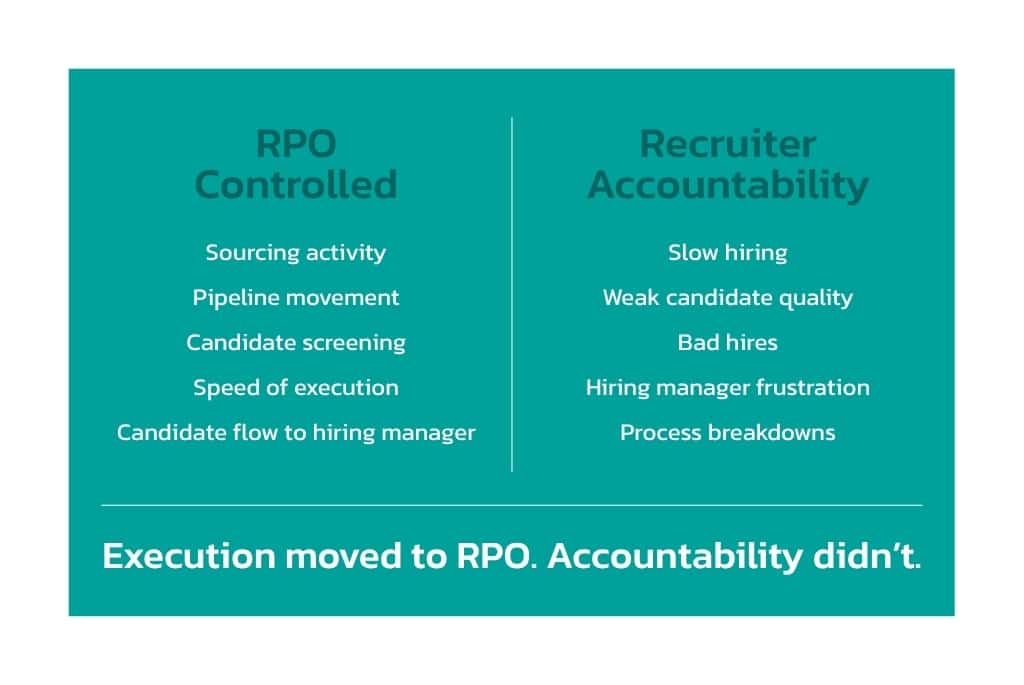
Here’s the bind: your internal recruiters still get blamed when hiring fails. But the RPO provider controls sourcing, screening, and who makes it to the hiring manager.
A bad hire shows up three months later? Nobody points at the vendor. They point at the recruiter who “should’ve caught it.” You’ve outsourced execution but kept responsibility in-house, and that creates defensiveness instead of teamwork.
Why RPO Tension Is Really a Governance Problem
Stop blaming this on personalities or resistance to change. The problem is unclear governance.
RPO adds capacity. It doesn’t replace your company’s judgment about who to hire. But most companies skip the hard work of defining decision rights, escalation paths, and quality ownership before the vendor starts.
McKinsey’s research on shared services found that many GBS programs fail to deliver expected impact because governance mechanisms were “designed and agreed upon by teams that were not accountable for day-to-day execution,” according to their analysis of IT services sourcing relationships. Organizations assume the outsourcing partner and internal team will “figure it out.” They won’t.
Someone has to design how these two systems interact, and that job belongs to leadership, not recruiters trying to protect their sanity.
If you’re blaming resistance on bad attitudes, you’re looking at the symptom instead of the cause.
How to Set Up the Relationship So It Actually Works
Redefine the Internal Recruiter’s Role Before RPO Launches
Make this brutally explicit before anyone signs anything.
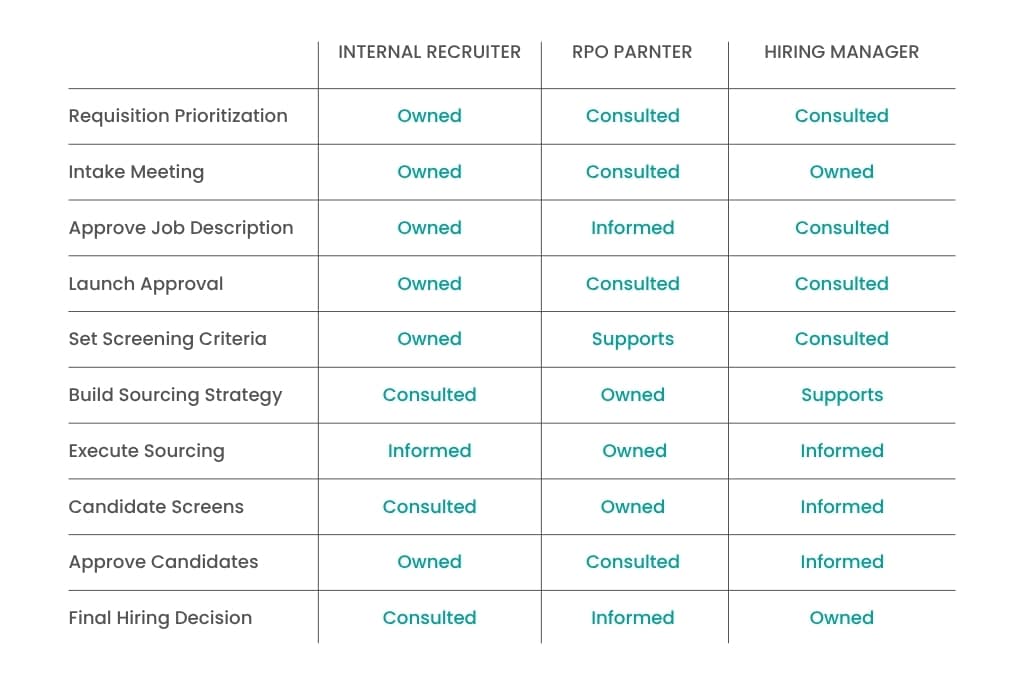
Your internal recruiters should own intake quality, set hiring standards, advise hiring managers, and make final calls on candidate fit. They’re the judgment layer.
RPO should execute sourcing at scale, manage pipelines, deliver speed and coverage. They’re the execution engine.
If you don’t write this down and get everyone nodding, your internal team will assume they’re being replaced. Your RPO partner will assume they own the whole process. Both will be wrong, and hiring will stall while they sort it out.
Here’s a good example of how to do this well: Before launching RPO, create a one-page document titled “Who Decides What.” Internal recruiters approve all job descriptions and make go/no-go calls on candidates before anyone reaches the hiring manager. RPO owns everything between “approved req” and “qualified candidate.” Clear lines, fewer arguments.
Make Internal Recruiters the Client, Not the Competitor
Your RPO team should report operationally through internal talent acquisition leadership. Internal recruiters approve role calibration and screening criteria before sourcing begins.
When RPO bypasses your recruiters and goes straight to hiring managers, you’ve told your team they don’t matter. Don’t act surprised when they stop cooperating.
Align Incentives Around Outcomes, Not Activity
If you’re measuring internal recruiters on quality and RPO on speed and volume, you’ve engineered misalignment into the metrics.
A better option? Track time-to-accept, hiring manager satisfaction and 90-day retention across both teams. Run joint reviews where both sides own the same results.
Deloitte’s Global Business Services Survey found that approximately 55% of organizations with strong GBS leadership and governance achieved over 20% average savings, highlighting the value of effective decision-making structures.
Divergent incentives create divergent priorities. And divergent priorities turn collaboration into performance art.
Keep Institutional Knowledge Where It Belongs
Your internal recruiters know which hiring managers need handholding, which teams churn candidates and which roles never fill because the job description lives in fantasy land. They translate your culture, understand manager psychology and remember what went wrong last time.
RPO providers can’t replace that. Don’t expect them to, and don’t blame them when they can’t read your company’s mind.
Treating RPO like a full replacement instead of a capacity boost guarantees you’ll lose the knowledge that makes hiring work in the first place.
What Internal Recruiters Need to Let Go Of (And What They Should Fight For)
Not all resistance makes sense. Hoarding resumes in personal folders? Manually sourcing when automation works fine? Gatekeeping just to gatekeep? That needs to stop.
But fighting for intake discipline, candidate quality standards and the authority to push back on garbage job specs? That’s the job. That’s what you pay them for.
Your internal recruiters aren’t there to do everything. They’re there to keep hiring from breaking when you scale.
When You Should Pause RPO
Some companies aren’t ready for RPO. Forcing it makes everything worse.
If you don’t have basic workforce planning discipline, if hiring managers bypass your TA team entirely, if leadership thinks RPO will magically fix deeper cultural or management dysfunction, stop.
RPO amplifies your operating model. Broken model, amplified problems, bigger bill.
Five Questions to Answer Before You Launch an RPO Campaign
Have you defined decision rights in writing? Do internal recruiters own quality? Does RPO own execution? Are metrics actually shared? Is someone specifically accountable for making the relationship work?
If you can’t say yes to all five, don’t blame your recruiters for resisting. Fix the structure you built.
Internal recruiters don’t hate outsourcing. They hate losing authority while keeping responsibility. Business owners who design the relationship carefully get both internal judgment and external scale working together instead of fighting.
If you’re serious about scaling hiring without imploding your team, treat this like the organizational design problem it is.
Need help structuring RPO so it doesn’t create a civil war?
Some RPO firms try to replace your internal recruiters. WorkRocket is here to empower them.
WorkRocket works with business owners to design partnerships that leverage external capacity without breaking internal teams. Let’s figure out what that looks like for you.
