
First-year employee attrition rarely shows up as a surprise resignation. It shows up as a pattern. The same jobs bleed talent. The same manager loses new hires. The same location keeps rehiring the same role.
The frustrating part is that most of it could have been predicted before the offer went out.
U.S. quit activity remains a defining feature of the labor market. The Bureau of Labor Statistics’ Job Openings and Labor Turnover Survey tracks voluntary separations at scale, month after month, across industries. The level and persistence of quits gives leaders a blunt message: people keep moving, and many will keep moving early.
That movement is expensive. SHRM estimates replacement costs can range from 50-200% of annual salary depending on role type and complexity. Even conservative assumptions put early exits into real money quickly.
This piece focuses on one practical lever that often gets mischaracterized: RPO.
Not “outsourced recruiting to fill more requisitions.” The version of RPO that actually changes retention outcomes. The version that forces role clarity, standardizes hiring, and ties onboarding execution to what was promised in the interview process.
You’ll get three things from the rest of the article:
- A clean way to think about attrition vs turnover so first-year risk shows up in metrics
- Insights into the real drivers of early exits, with data that supports them
- A practical model for using RPO to reduce the attrition rate by tightening expectation-setting and onboarding follow-through
Table of Contents
What Employee Attrition Means
Employee Attrition Definition
Employee attrition refers to workforce reduction from departures such as resignations and retirements, often without immediate replacement. It usually signals a net loss of headcount or capacity over time.
Turnover is a broader bucket. It typically includes voluntary and involuntary exits and may include backfills. That difference matters in reporting, but first-year risk management cares less about labels and more about timing.
Why The First Year Behaves Differently
First-year employee attrition behaves differently because the employment relationship is still fragile. The employee has not built internal reputation, social ties, or a sense of trajectory. The manager has not built trust in execution. The systems still feel unfamiliar.
When someone exits within the first 9 months, it rarely reflects a sudden change. It reflects accumulated friction that never got resolved.
Why Employees Leave in the First Year
Plenty of teams blame compensation when employees leave. That’s a convenient answer because it turns into a budget debate instead of a process critique.
Pay matters, especially in competitive labor markets but early exits still cluster around something more basic: expectation alignment and early support.
Expectation Gaps Start Before Day One
Leadership IQ’s research found that 46% of new hires fail within 18 months, with common reasons tied to coachability, emotional intelligence, and fit. Those factors often show up as “this is not what I signed up for” on both sides.
Gallup’s annual U.S. engagement update found that only 46% of employees clearly know what is expected of them at work, down from 56% in March 2020.
That expectation gap often forms in small moments:
- A job description promises autonomy, but the manager runs approvals through three layers
- The interview sells growth, but the role stays task-heavy and stagnant for months
- The manager says “fast-paced,” but means “no priorities and constant fire drills”
None of those problems show up in the ATS. They show up in first-year attrition.
Weak Onboarding Turns Small Doubts into Exits
Onboarding gets treated as orientation too often. Paperwork. Badges. A laptop that shows up late.
SHRM reports that organizations with a standard onboarding process experience 50% greater new-hire retention, and employees who go through structured onboarding are 69% more likely to remain with the company for three years.
BambooHR’s onboarding research highlights how quickly employees form stay-or-leave intent, often within the first six months.
In practice, weak onboarding creates a very specific experience. The new hire spends the first month guessing what “good” looks like. The manager stays busy. Training feels disconnected from the real work. The employee starts looking at job boards at night.
This is how small doubts slowly turn into a turnover.
Managers Drive Most of the Variance
Managers sit at the center of early retention because they translate the job into a lived experience. Gallup has argued that managers account for nearly 70% of variance in engagement. Engagement, in turn, correlates with retention risk and performance outcomes.
If the manager can’t define what success looks like within the role, can’t coach early performance, and can’t integrate the person into the team, no recruiting model can save the hire.
That said, recruiting can prevent many of these issues by forcing clarity and alignment earlier.
Where Traditional Recruiting Models Break the Chain
Most internal talent acquisition teams are measured on speed, volume, and offer acceptance. Those are not retention metrics.
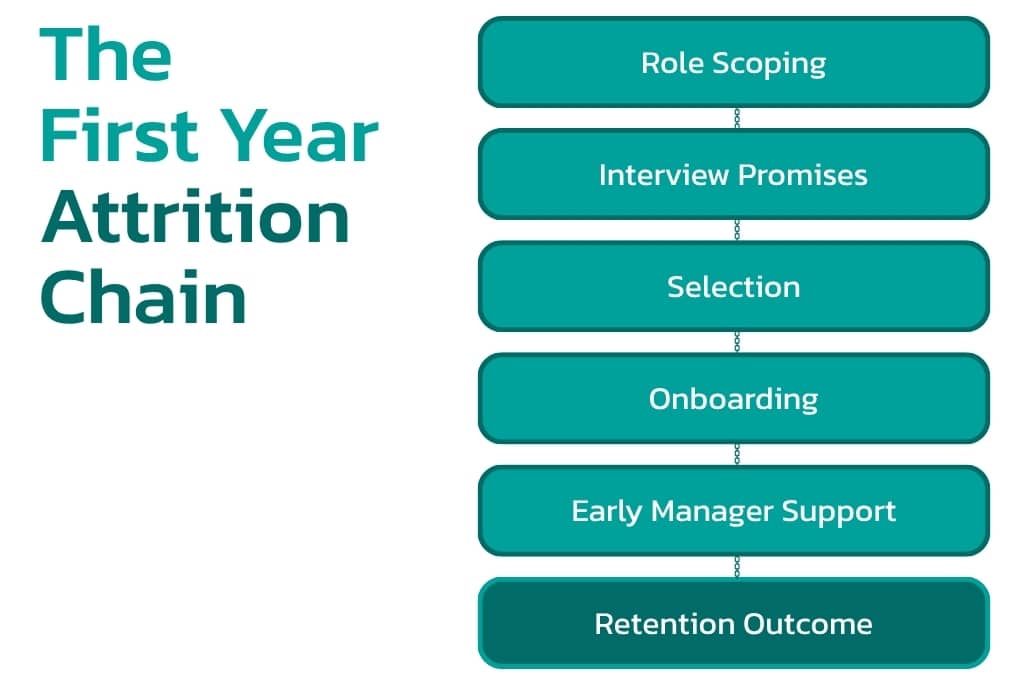
Onboarding often sits elsewhere. Managers do their own thing and HR tries to standardize without touching manager behavior too directly. This creates a chain with weak links, and early attrition finds the weakest one.
The U.S. Government Accountability Office (GAO) has emphasized that strategic human capital management must be tightly aligned with organizational missions and supported by meaningful performance measures. In its testimony on driving transformational change, GAO argues that workforce strategies cannot operate in isolation from business outcomes. When hiring and onboarding practices are not linked to measurable results, leaders lack the visibility needed to identify and correct retention problems early.
When the recruitment team hands off a candidate without shared definitions of success, onboarding can’t anchor the person properly. Everyone does “their part,” yet the system fails.
That is where the right RPO model changes structure, not just capacity.
How RPO Changes First-Year Employee Attrition Outcomes
What RPO Means in This Context
Recruitment Process Outsourcing (RPO) means an external partner takes responsibility for some or all recruiting processes. The retention impact comes from how the partner operates.
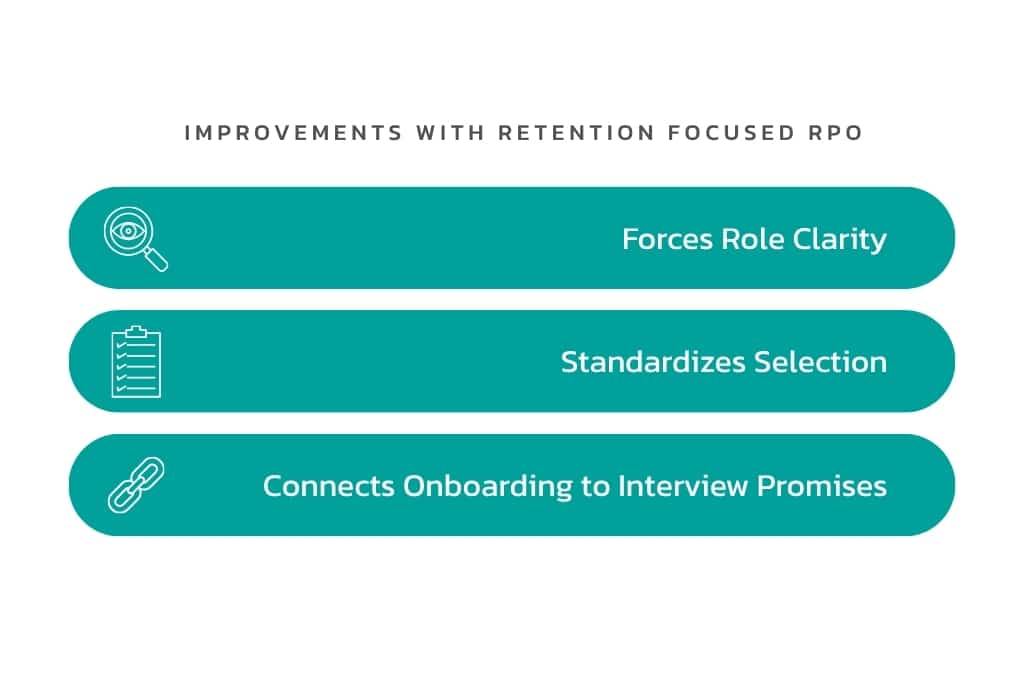
A retention-oriented RPO does three things differently:
- It forces role clarity at intake
- It standardizes selection so hiring decisions follow evidence
- It ties onboarding expectations to what was promised during recruiting
If RPO only provides sourcing muscle, it will not move first-year employee attrition. It will just fill seats faster.
Role Scoping Becomes a Real Discipline
Job descriptions often read like a wish list. Role scoping turns that list into something measurable.
The U.S. Department of Labor’s O*NET program provides a structured framework for understanding occupations in terms of tasks, skills, and work context. It’s a reminder that roles can be defined with real specificity rather than generic requirements.
A strong RPO intake does not just ask, “What are the requirements?” It asks:
- What does success look like at 30, 60, 90 days?
- What causes failure in this role historically?
- Which skills matter on day one, and which can be learned?
- Which manager behaviors help this role thrive, and which make it collapse?
That conversation often feels uncomfortable but it’s necessary to define success.
Hiring Manager Calibration Stops Randomness
Without hiring manager calibration, your team may get the end of interviews and realize they evaluated entirely different things when they compare notes. This misalignment is what leads to candidates being chosen for the role based on the wrong criteria.
RPO brings consistency through:
- Interview guides tied to a success profile
- Consistent evaluation criteria across interviewers
- Decision debriefs that focus on evidence, not personality preference
This is one of the quieter ways RPO reduces attrition.
Onboarding Alignment Becomes Part of the Hiring System
Onboarding fails because no one treats it like a continuation of recruiting.
A retention-focused RPO program formalizes the handoff. It makes sure the onboarding plan matches the promises of the role.
That can include:
- A documented 30-60-90 plan created during intake and reused in onboarding
- A first-week manager checklist focused on clarity and relationship building
- Early check-ins that surface mismatch signals before month 3
- Feedback loops that update the selection profile when early exits occur
McKinsey’s research on organizational health shows that management practices, leadership quality, and role clarity strongly correlate with performance outcomes. When onboarding reinforces those practices early, retention risk decreases.
This is not theory. When the manager begins week one with a clear definition of success and a rhythm of feedback, the new hire stops second guessing. Second guessing fuels exits.
How To Measure the RPO Attrition Rate Without Fooling Yourself
RPO Attrition Rate Definition
The RPO attrition rate measures the percentage of hires made through an RPO program who exit within a defined window, often 90 days and 12 months.
The key is comparison.
The Comparisons That Actually Matter
These comparisons expose root causes of attrition:
- RPO hires vs non-RPO hires in the same job family
- Attrition by hiring manager for the same role
- Attrition by site or shift for the same role
- Early performance ratings vs retention outcomes
A clean measurement system turns first-year attrition from a complaint into a solvable operational problem.
The Money Is Big, But the Volatility Is Worse
Cost-of-turnover gets quoted constantly. The more damaging piece often hides behind it: volatility.
When early attrition spikes, teams lose planning stability. Production schedules wobble. Sales territories reset. Customer relationships restart. Managers spend nights interviewing instead of leading.
This is where first-year attrition becomes a governance issue for executives. Leaders do not just want lower average attrition. They want lower variance. They want fewer surprise months where the team gets hollowed out.
RPO can reduce variance because it forces consistency in role scoping, selection, and onboarding execution. Consistency reduces randomness. Randomness creates spikes.
That is a competitive advantage most companies underestimate.
What Changes In 2026 And Why It Matters
Work remains more distributed than it used to be. New hires can’t rely on informal learning and hallway context. They need explicit clarity earlier.
Meanwhile, mobility remains high. JOLTS continues to track millions of quits monthly. A company that loses new hires quickly will not “wait it out.” It will keep paying the churn tax.
The companies that win in 2026 will treat first-year retention as a system design problem:
- Design the role clearly
- Select against that design
- Onboard against the same design
- Measure results, then adjust
RPO fits into that system when it holds part of the accountability, not just the sourcing workload.
What To Track If Employee Attrition Needs to Drop
If leadership wants fewer early exits, the metrics must match the goal.
Track these consistently:
- 90-day retention by role and manager
- 6-month retention by role and manager
- Time-to-productivity benchmarks by job family
- Onboarding completion tied to manager actions, not just HR tasks
- Early performance indicators that correlate with exit risk
Then make the next hiring intake meeting different. Require the manager to define 90-day success. Require interviewers to score against that definition. Require onboarding to reflect it.
That is how attrition drops without guessing.
Where WorkRocket Fits
WorkRocket’s best value in an RPO model comes from tightening the relationship between recruiting and onboarding as a direct prevention method against first-year employee attrition.
If a company can measure early exits, identify the recurring failure points, and standardize role clarity and onboarding execution, early attrition becomes manageable. Not eliminated. Managed.
A practical next step: audit one job family with high first-year exits. Compare manager-level attrition patterns. Review the intake notes, interview guides, and onboarding plan side by side. Any mismatch will show up fast.
That is where real retention gains start.
For help improving your hiring process and employee attrition, reach out to the team at WorkRocket.
