
Recruitment process outsourcing doesn’t solve hiring problems. It amplifies whatever system already exists.
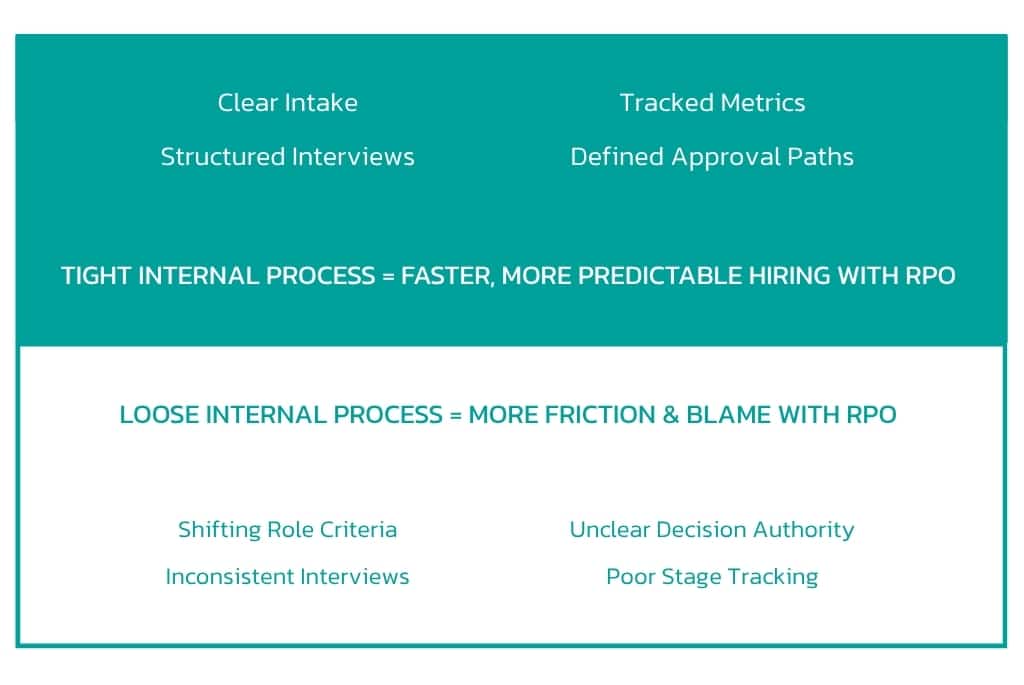
If the internal hiring process is tight, outsourcing increases throughput. If the process is loose, outsourcing increases friction. The difference shows up quickly, usually within the first quarter of implementation.
An outsourcing readiness assessment is not a formality before vendor selection. It’s a diagnostic assessment of whether the organization can run a predictable hiring system once recruiting activity is shared.
By the end of this article, you’ll understand what internal capabilities your team needs to possess to effectively outsource your recruitment and you’ll walk away with an outsourcing readiness checklist that you can use to assess your internal team.
Process Maturity Decides Whether Outsourcing Works
Most outsourcing breakdowns are blamed on the vendor. In reality they trace back to internal inconsistency.
Consider how hiring actually moves. A requisition opens. Intake happens. Sourcing begins. Interviews occur. An offer is drafted. Approvals are gathered. The candidate responds.
Every one of those stages sits inside an internal workflow.
If approvals take 10 days internally, an RPO partner cannot shrink that delay. If interviewers evaluate candidates differently, more interviews get scheduled. That extends cycle time regardless of sourcing volume.
The Internal Hiring Capabilities That Must Exist for Successful Outsourcing
An outsourcing readiness assessment should test for a few capabilities that sound basic but tend to be missing when outsourcing fails.
Role Intake Discipline
A serious readiness assessment starts at intake, not sourcing.
Does the hiring manager agree on what the role is accountable for in its first year? Is compensation aligned to market data, or is it aspirational? Are “must-have” skills actually required, or are they habits from the last person who held the job?
When intake criteria shifts after candidates enter the funnel, searches quietly restart. The RPO team adjusts sourcing criteria. Shortlists change. Hiring managers complain about fit. The hiring clock resets.
That is not an outsourcing failure. It’s a direct consequence of an intake process that lacks discipline.
Interview Structure
Many organizations assume their interviews are working because hires are eventually made. That’s not the right test. The right test is whether interviewers evaluate candidates against a shared criteria.
OPM’s structured interview guidance explains how consistent questions and rating approaches improve decision quality and comparability.
Research aligns with that guidance. A recent meta-analysis in the Journal of Applied Psychology found structured interviews predict job performance more accurately (.44 validity) than unstructured interviews (.33).
If interviews lack structure, candidates receive mixed signals, hiring managers disagree more often, and second or third interviews get added to resolve uncertainty. Adding outsourcing to an unstructured interview process only accelerates the flow of candidates into a decision bottleneck.
Clear Decision Authority
Speed doesn’t improve when leadership asks for urgency. It improves when decision authority is clear.
Who can approve compensation exceptions? Who can veto a finalist? How long can an offer sit before escalation? Without defined answers, recruiting partners spend time chasing internal approvals rather than advancing candidates.
Offer timing affects acceptance rates. A field study published in Personnel Psychology found that earlier offers were associated with higher acceptance.
The takeaway is this: Slow internal decision cycles reduce acceptance probability.
Baseline Measurement Data
Outsourcing without baseline data invites blame.
A readiness assessment should confirm that the organization can track:
- Interview-to-offer ratio
- Offer acceptance rate
- Requisition aging causes
This data shows whether delays come from the vendor or from inside your organization. Without that clarity, performance reviews become opinion-based, and companies often replace vendors because of problems they created themselves.
Governance and Workforce Planning Are the Real Readiness Test
A well-structured process keeps hiring moving. Governance prevents outsourcing from reshaping power dynamics inside the organization.
Workforce planning sits at the center of that governance.
OPM’s workforce planning framework outlines a structured approach to assessing workforce supply, forecasting demand, and identifying gaps.
If roles are open without a clear hiring plan, the RPO team keeps shifting priorities. That leads to unstable candidate pipelines and uneven results.
Partnership Ownership Requires Authority
Ownership means more than attending quarterly business reviews.
An accountable leader should run weekly pipeline reviews, enforce response time standards, approve messaging changes, and escalate stalled decisions. Without that authority, the vendor is left to make their own assumptions on how they should proceed.
Many outsourcing failures stem from split accountability. HR manages the contract. Business leaders control hiring decisions. Finance controls compensation exceptions. No single person has full authority over outcomes.
An outsourcing readiness assessment should surface that fragmentation before implementation.
Compliance and Risk Oversight Cannot Be Handed Off
Recruitment touches regulated ground: discrimination law, selection validity, and data handling. The EEOC outlines federal equal employment opportunity laws that employers remain responsible for, regardless of who executes hiring steps.
The Uniform Guidelines explain how to check whether hiring tools give unfair disadvantages to certain groups and how to document that those tools are job-related and are properly validated.
If a vendor introduces new screening tools, knock-out questions, or assessment technology, the employer still owns the legal exposure. With the rise of AI screening tools, this is increasingly important to be aware of.
Recruitment outsourcing should be treated as part of your risk landscape, not as an isolated HR transaction.
Labor Market Pressure Exposes Internal Weakness Quickly
Certain sectors face persistent hiring volume from both growth and replacement needs. Healthcare is one example. BLS projects about 1.9 million openings per year, on average, in healthcare practitioner and technical occupations.
In markets like this, your internal team must be able to give candidates a hiring experience that instills confidence in your organization.
Candidate Experience Erodes Without Structure
Research on applicant reactions shows that communication delays and perceived unfairness negatively influence whether candidates would reapply or recommend the employer.
If hiring managers delay feedback or contradict each other in interviews, candidate experience erodes regardless of sourcing effort.
Manager Capability Shapes Hiring Outcomes
Gallup’s workplace research consistently shows that managers have the ability to influence engagement levels.
Hiring quality and retention are closely connected to manager performance. Gallup’s workplace research shows managers account for roughly 70% of the variance in employee engagement, and engagement levels strongly influence turnover and performance outcomes.
Recruitment outsourcing can expand candidate reach. It cannot compensate for weak interviewer skill, unclear expectations, or inconsistent onboarding.
A Practical Outsourcing Readiness Assessment
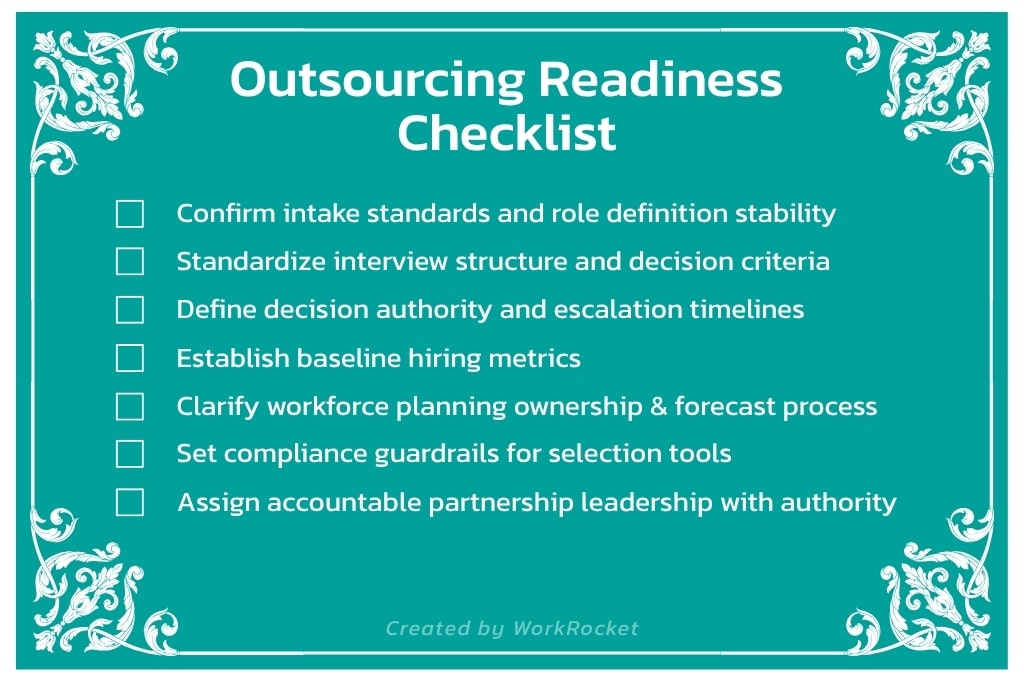
A disciplined sequence clarifies readiness:
- Confirm intake standards and role definition stability
- Standardize interview structure and decision criteria
- Define decision authority and escalation timelines
- Establish baseline hiring metrics
- Clarify workforce planning ownership and forecast process
- Set compliance guardrails for selection tools and data handling
- Assign accountable partnership leadership with authority
Organizations that complete these steps tend to implement recruitment process outsourcing with fewer resets and clearer performance conversations.
Closing Perspective
Recruitment process outsourcing is an operating model choice. It changes how work flows, how decisions are made, and how risk is managed.
An outsourcing readiness assessment determines whether outsourcing strengthens the hiring system or exposes instability that already exists.
How does your system hold up to the test?
