
With the current cost of talent acquisition, companies everywhere are examining their hiring models more closely than ever. The core question isn’t just “can we fill the role?” but “how fast, how well, and at what cost can we fill this role?” For many organizations, the choice is between relying on internal recruitment (managing the hire entirely in-house) versus outsourcing part or all of the process via aRecruitment Process Outsourcing (RPO)partner. At WorkRocket, our focus is helping companies optimize hiring outcomes; and selecting the right model is key.
This article examines the hidden costs of internal recruitment, compares them with the true cost potential of RPO services, and gives actionable insights so you can evaluate the best approach for your organization.
What Do We Mean by Internal Recruitment and RPO?
Internal recruitment refers to when your organization uses its own HR or talent acquisition (TA) resources (or builds them) to handle everything related to recruitment: sourcing, screening, interviewing and onboarding. Your business bears all the direct and indirect costs: recruiter salaries, job-board subscriptions, applicant tracking systems (ATS), training, and overhead.
RPO (recruitment process outsourcing) refers to partnering with an external provider who takes over some or all of the recruitment process. The provider may provide sourcing pipelines, screening, interview coordination, onboarding support, analytics and even employer-branding. You pay for outcomes or service levels rather than maintaining full internal infrastructure for all hiring.
Hidden Costs of Internal Recruitment
At first glance, managing hiring internally may appear more economical: you already have HR staff, you control the brand, and you may avoid outsourcing fees. But many hidden costs can make internal recruitment significantly more expensive than anticipated. The major cost-areas to consider include:
1. Fixed Overhead and Underutilization
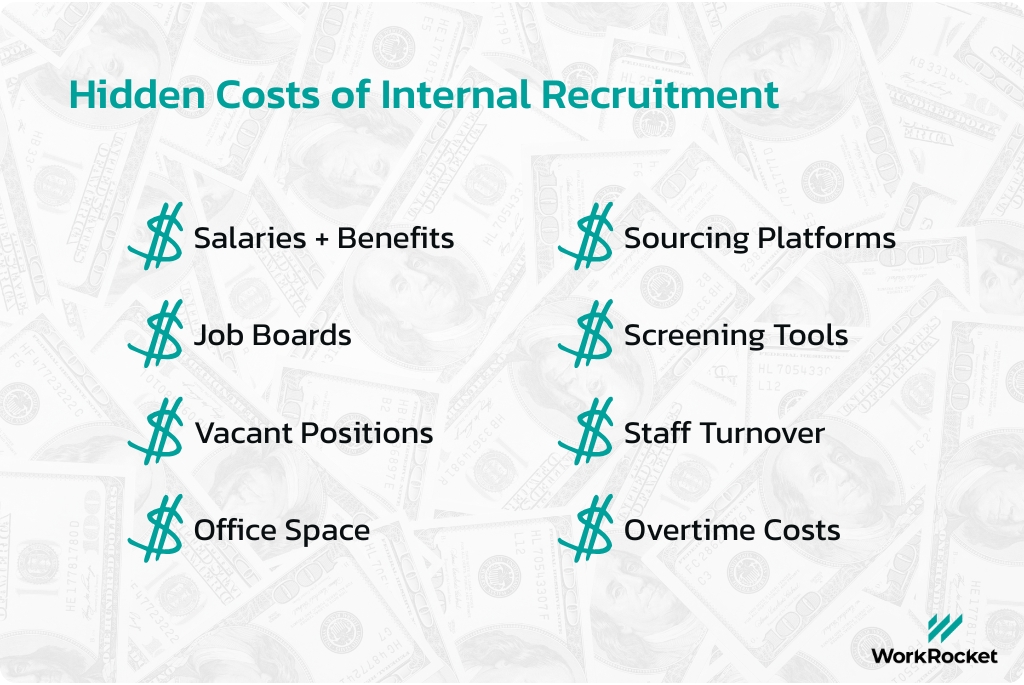
With internal recruitment, you carry fixed costs (regardless of hiring volume): salaries of internal recruiters, benefits, training, ATS licenses, job-board subscriptions, office space, infrastructure and other overhead costs. If your hiring volume is unpredictable or low in some periods, the cost per hire goes up significantly.
2. Delayed Time-to-Fill and Its Opportunity Cost
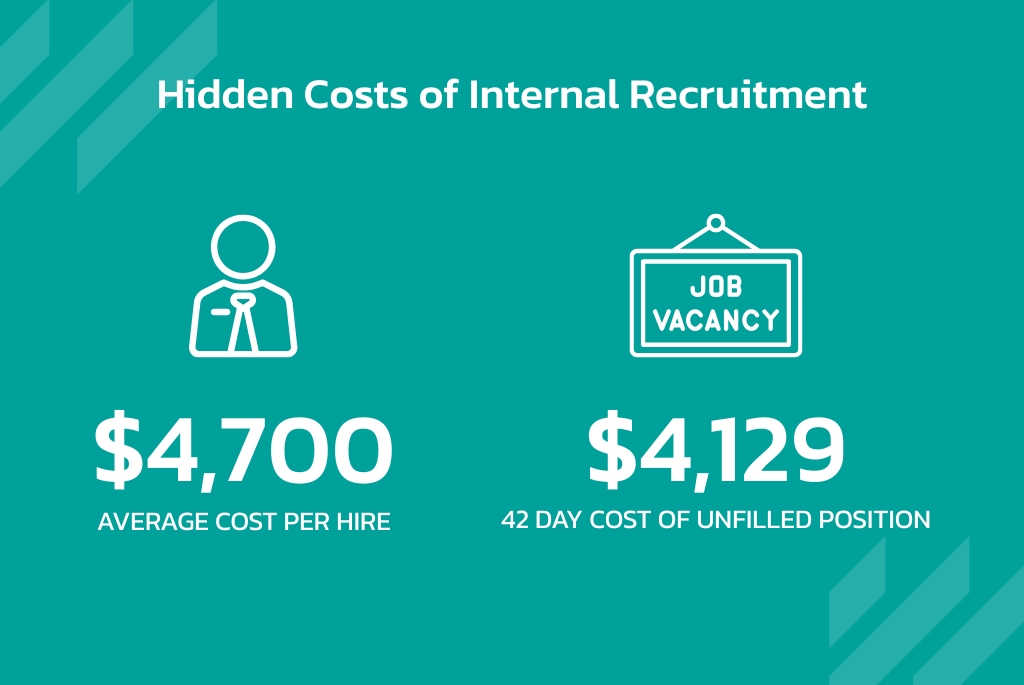
Vacant roles carry a real cost. According to one study, over a 42-day vacancy period, each unfilled position costs companies an average of $4,129. For revenue-generating roles, the cost can skyrocket to as high as $7,000-$10,000 per month. Longer hiring cycles mean higher hidden costs, especially when internal teams are stretched thin.
3. Under-Accounted Tool & Infrastructure Costs
Internal recruitment teams need to invest in technology (ATS, sourcing platforms, screening tools), job-board subscriptions, marketing, training and infrastructure. Even if many costs are “already there”, they should be allocated to the recruitment function to reflect the true cost of internal recruitment. According to HR analytics guidance, the average cost per hire across industries is around $4,700 in the U.S. If you underestimate your internal expenses, you might be assuming internal recruitment is cheaper than it really is.
4. Quality of Hire, Turnover and Ramp-Up Risk
When internal recruiters are overloaded or lack specialized sourcing domain expertise (for niche or high growth hiring), the risk of low-quality hires increases. Poor quality hires carry costs: re-hiring, training, lost productivity, morale issues. The “quality of hire” metric is often harder to quantify but is increasingly considered a key driver of recruitment effectiveness.
5. Scalability and Risk of High Volume or Surge Hiring
When business growth accelerates (e.g., seasonal hiring, new product line, geographic expansion), an internal TA team may struggle to scale quickly. That can drive overtime costs, hiring manager overload, agency fees for overflow, and high cost-per-hire. Internal recruitment may appear cheaper when hiring volume is stable and low, but the hidden costs of scaling “ad-hoc” tend to be high.
6. Cost-Per-Hire and Vacancy Cost Benchmarks
Here are some key figures to ground the comparison:
- The average cost per hire across industries in the U.S. is around $4,700.
- For senior/executive jobs, the cost-per-hire is significantly higher: according to Society for Human Resource Management (SHRM) benchmarking, the cost-per-hire for executives rose 21% since 2022 and 113% since 2017.
These figures illustrate that internal recruitment costs and the cost of delays are substantial.
The Cost Model of RPO and How to Compare
If internal recruitment carries these hidden costs, where does RPO fit in? And what should you compare?
What You Typically Pay for with RPO
When an organization engages an RPO model, key cost features often include:
- A fee structure based on outcomes (e.g., cost-per-hire, volume-based, retainer) or service level rather than fixed full-time recruiter overhead.
- Embedded sourcing, screening, pipeline-generation infrastructure (reducing the burden on internal HR).
- Scalability: ability to ramp up or down with hiring volumes, reducing the “fixed cost” risk of internal-only models.
- Access to recruiting expertise, tools and analytics that may be more efficient than building solely internally.
WorkRocket’s Flat Fee RPO Services
At WorkRocket, we charge a flat fee for our RPO services. You will receive all of the benefits of a typical RPO service, but the price will be paid upfront when expectations are set. If we cannot meet your expectations for any reason, we offer a money back guarantee on your first campaign so that you don’t have to worry about the risk of using a new service.
How to Compare the Cost of Internal Recruitment vs RPO
Here are some steps to evaluate:
- Calculate your internal recruitment full-cost: This includes recruiter/TA salaries & benefits, job-board and advertising spend, ATS/tools allocation, hiring manager time, onboarding/training costs, turnover/mis-hire risk, vacancy costs (lost productivity).
- Benchmark your internal metrics: For example, cost-per-hire ~ $4,700 average in U.S., and vacancy cost for some roles runs into tens of thousands of dollars.
- Estimate the hidden cost of delays: e.g. a software engineer role open 56 days cost ~$60,606 in one example.
- Estimate RPO scenario: What would you pay under an outsourced model (per-hire fee, flat fee or retainer)? What improvements in time-to-fill, quality, and scalability would you gain? Even if RPO fees are higher per hire than minimal internal cost, the net savings may come from faster fill, improved quality, fewer bad hires, lower vacancy cost, and scalability.
- Build a business case: For example: If internal recruitment results in an average vacancy cost of $50k per open role + cost-per-hire ($4,700), but an RPO model could reduce vacancy days by 20 days and thereby reduce vacancy cost by ~$20,000, the incremental RPO fee may be justified.
- Hybrid model: In many cases, organizations adopt a hybrid model; internal recruitment for steady-state hiring, and RPO for high-volume, surge, or niche roles. That may yield better cost-control and flexibility.
For WorkRocket Clients: Decision-Making Framework
At WorkRocket, we partner with organizations to build the right hiring model. Here is a simple decision-making framework for evaluating internal recruitment vs RPO:
Assess your hiring volume & variability
- How many hires do you make per month/year?
- Is hiring relatively consistent, or do you face surges (seasonal hiring, expansion, acquisition)?
- If volume is low and predictable, internal recruitment might work. If volume is variable, growing fast, or you require specialized talent, RPO becomes attractive.
Estimate your internal full cost model
- Calculate recruiter/TA salaries + benefits allocated to hiring.
- Add job-board/advertising, ATS/tools, hiring-manager time, onboarding training, turnover/remediation cost.
- Add vacancy cost: For example, an open role may cost tens of thousands of dollars in lost productivity.
- Determine cost-per-hire compared to benchmark (~$4,700 for many U.S. companies) to see if you are above or below average.
Benchmark against what you could achieve with RPO
- Estimate how much time-to-fill you could save and what that translates to in reduced vacancy cost.
- Estimate how many quality improvements or turnover reductions you could obtain (harder to quantify but important).
- Estimate RPO fee or internal cost + external cost hybrid.
Factor in hidden costs
- The cost of vacancies and lost productivity is high.
- The cost of mis-hires and early turnover.
- Scalability risk when hiring volume spikes.
- The burden on hiring managers and internal TA team (opportunity cost of their time).
- The cost of technology and infrastructure that internal recruitment may already be absorbing but may be under-allocated.
Decide the best fit
- If internal recruitment gives you predictable costs, strong quality, and you can scale, then internal might be optimal.
- If you’re facing high growth, variable volume, niche talent or slow internal processes, RPO or a hybrid may deliver better ROI.
Track metrics continuously
- We regularly send out metrics reports on your campaigns
- For whichever model you choose monitor: cost-per-hire, time-to-fill, quality of hire (e.g., performance, retention), hiring manager satisfaction and candidate experience.
- Re-evaluate annually or when the business changes (growth phase, new markets, change in role types).
Key Take-Aways for Hiring Leaders
- Managing hiring solely via internal recruitment may look cost-effective initially, but hidden costs (vacancy cost, turnover risk, scalability limits, infrastructure investment) often make it more expensive than assumed.
- The benchmark cost-per-hire for many U.S. companies is around $4,700, with highly specialized or executive roles being significantly higher.
- The cost of vacancy (open unfilled roles) can run into tens of thousands of dollars per role when you account for lost productivity and revenue.
- An RPO model shifts many of these hidden cost risks to a service provider and offers scalability, access to tools/expertise and sometimes faster fill and higher quality.
- The decision is not simply “internal recruitment vs RPO” in all cases; often a hybrid approach is optimal, depending on role types, volume, growth and internal capability.
- At WorkRocket we help you build the model that best fits your business and ensure you’re not underestimating internal recruitment costs or overlooking hidden savings via outsourcing.
- Our service is completely customizable to the needs of your company
Why WorkRocket is Uniquely Placed
WorkRocket brings deep experience in talent acquisition strategy, sourcing optimization and recruitment process outsourcing models. Here’s what we deliver:
- Transparent cost modelling of internal recruitment vs RPO for your business.
- Access to recruiting infrastructure, analytics and networks typically found in outsourced models but tailored to your needs.
- Hybrid frameworks: you keep core internal capability while we scale flexibly for surges or specialized hiring.
- Continuous KPI tracking and optimization of recruitment performance (cost-per-hire, time-to-fill, quality) so you can see your ROI.
- Choice of services: we let you customize your strategy in the way that best fits the needs of your business.
If you’re facing scaling hiring challenges, unpredictable demand or slow internal processes, now is the time to evaluate your hiring model, optimize cost, improve talent quality and accelerate time to productivity. Contact WorkRocket to explore how we can help you build a leaner, faster and more cost-effective hiring engine.
