
If your organization is trying to decide whether to build an in-house recruitment team or partner with an RPO provider, you’re not alone. With competition for talent tougher than ever, companies are re-evaluating their entire recruitment strategy; not just how to hire faster, but how to improve quality, reduce costs, and scale reliably.
This guide breaks down the data, pros, cons, and tradeoffs of in-house recruitment vs RPO and gives you the next steps to take in finding the best recruitment strategy for your business.
Let’s get into it.
Table of Contents
What “In-house Recruitment” and “RPO” Actually Mean
Before comparing cost and performance, we should get aligned on terms.
In-house Recruitment
This is when a company hires and manages its own internal team of recruiters. They handle everything: sourcing, screening, interviewing, scheduling, candidate experience, and onboarding. Full control, full ownership, full responsibility.
RPO (Recruitment Process Outsourcing)
This is where a company partners with an external provider, to manage part or all of the recruiting functions. RPO teams operate as an extension of the employer’s HR team, bringing specialized expertise, tools, sourcing networks, and scalable recruiting capacity.
A growing number of companies even adopt a hybrid recruitment strategy: in-house teams focus on leadership or culture-critical roles, while an RPO provider handles high-volume, repetitive, or hard-to-fill positions more efficiently.
Cost: Which Model Actually Saves You More Money?
Let’s start with the most objective metric: cost per hire.
The Real Cost of In-house Recruiting
SHRM reports that the average cost per hire in the United States is about $4,700.
But SHRM itself notes that this number increases significantly once you include productivity loss, recruiter salaries, job ads, tools, assessment software, and onboarding time.
Other research digs deeper:
- Some analysts estimate that when you include indirect costs (like manager time and vacancy impact), the total cost per hire can exceed $28,000.
- Specialized or technical roles almost always exceed the average due to increased sourcing difficulty.
And here’s a big hidden cost:
In-house recruitment teams represent fixed, ongoing expenses (recruiter salaries, benefits, training, ATS subscriptions) even when hiring slows or freezes.
How RPO Changes the Cost Structure
When an organization partners with an RPO service, much of the recruiting infrastructure becomes variable rather than fixed.
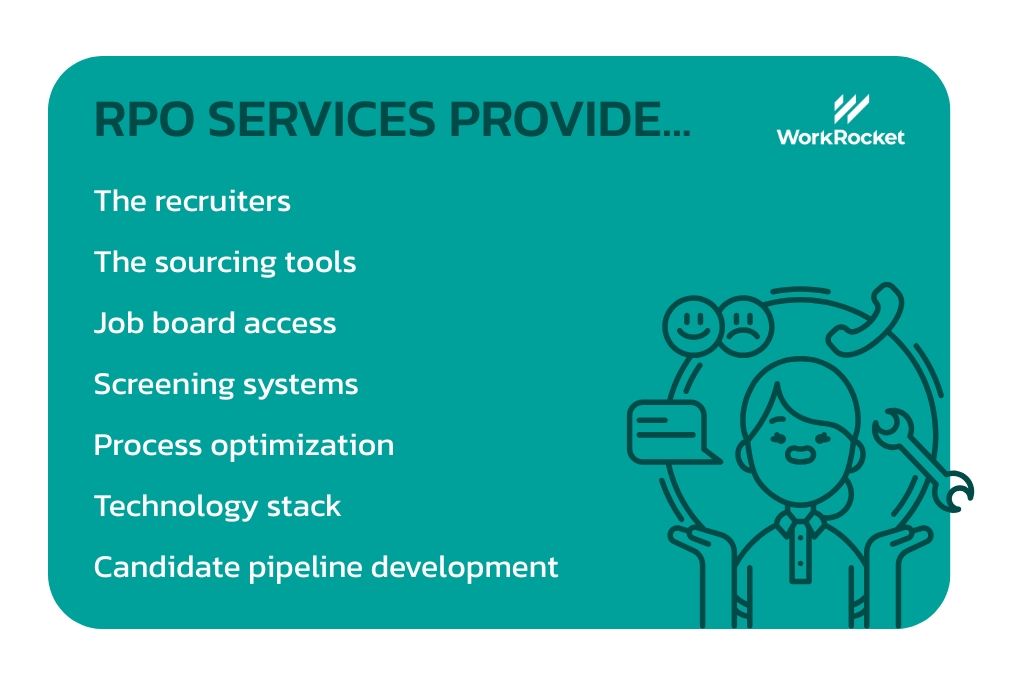
Recruitment process outsourcing provides:
- The sourcing tools
- Job board access
- Screening systems
- Process optimization
- Technology stack
- Candidate pipeline development
This bundling means clients don’t have to maintain expensive internal recruiting overhead.
Various industry analyses have shown:
- RPO can reduce cost per hire by 25–50%.
- RPO is particularly cost-effective for remote or multi-location hiring, where internal teams struggle to scale efficiently.
- Some companies experience even greater savings once vacancy-time reductions and recruiter salary offsets are factored in.
Bottom line:
If your hiring volume fluctuates, your roles are hard to fill, or you’re operating across multiple locations, an RPO model almost always delivers a lower total recruitment spend than in-house recruitment.
Speed: Who Hires Faster?
Every day a role sits unfilled costs companies thousands in lost productivity, delayed work, and burned-out staff. Because of this, it’s important to be aware of some of the limitations that in-house recruiting can present when it comes to time to hire.
In-house Recruiting Speed Limitations
Internal teams typically face:
- Limited candidate pipelines
- Slower sourcing cycles
- Competing HR priorities
- Inefficient manual processes
- Limited access to passive candidates
Analysts have noted that in-house setups often produce longer hiring cycles due to bandwidth constraints.
Hiring demands rarely arrive at a consistent pace, so when volume spikes, internal teams can get overwhelmed fast.
How RPO Overcomes Time to Hire Limitations
RPO services typically excel at fast hiring because:
- Dedicated teams focus exclusively on recruiting
- They leverage sourcing automation
- They maintain large candidate pipelines, including passive talent
- They can scale up instantly when hiring surges
A recent case study we ran showed that RPO services can save internal teams hundreds of hours per year. Faster hiring provides a competitive advantage, especially in tight labor markets where candidates are off the market within days.
The Benefits of Faster Hiring
Fast hiring gives companies:
- Lower vacancy costs
- Better retention (slow processes lose good candidates)
- Stronger morale among existing employees
- Quicker ramp-up for core projects
- The ability to capitalize on market opportunities
If your organization is struggling to fill roles on its own in a timely manner, it may be helpful to consider an RPO service. Having a dedicated team to help your recruitment efforts can often ease the burden of recruiting and shorten your time to hire.
Performance & Quality: Who Delivers Better Hires?
Cost and speed mean nothing if the hires don’t stick or worse, underperform.
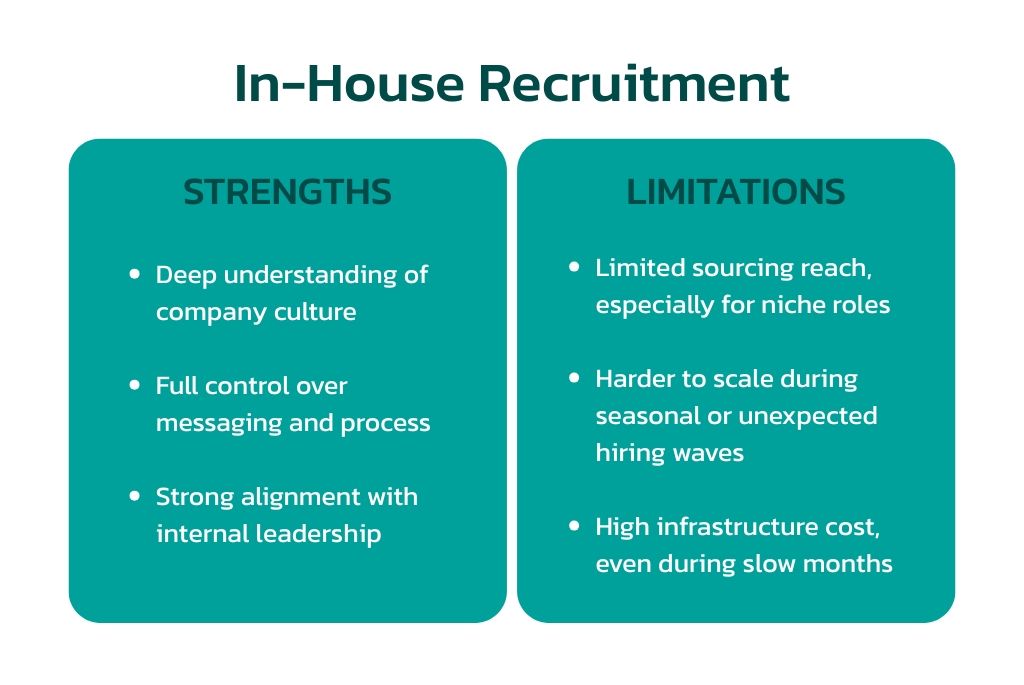
In-house Recruiting: Strengths and Limitations
Strengths:
- Deep understanding of company culture
- Full control over messaging and process
- Strong alignment with internal leadership
Limitations:
- Limited sourcing reach, especially for niche roles
- Harder to scale during seasonal or unexpected hiring waves
- High infrastructure cost, even during slow months
RPO: How Outsourced Recruiting Performs
RPO services focus on quality and fit just as much as speed and cost.
Analysts note these advantages:
- Access to broader networks = stronger candidate pools
- Better screening through structured, data-driven processes
- Lower turnover thanks to better alignment between candidate and role
- Improved candidate experience = higher acceptance and retention
- RPO often acts as a consultative partner, optimizing hiring processes and improving hiring manager satisfaction
In short:
An RPO model improves workforce performance through better sourcing, better matching, and better process efficiency.
In-house Recruiting vs RPO: Which to Choose
When In-house Recruitment Usually Excels
- You’re hiring regularly and predictably
- Cultural alignment is the single highest priority
- You have strong internal TA infrastructure
- You can afford recruiter salaries + tools
- Leadership roles dominate your hiring needs
When RPO Services Typically Excels
- Hiring volume fluctuates
- You need to scale rapidly
- You’re hiring across multiple locations
- Roles are repetitive, technical, or hard to fill
- You want faster hiring cycles
- You want variable (not fixed) recruiting costs
- You need better sourcing reach and candidate pipelines
- You want improved screening and reduced turnover
In-house recruiting can be a great way to hire employees if you are looking for someone who needs to be deeply integrated into your company culture or if your team wants to keep full control of your employer branding.
However, if your team is struggling to find candidates or is overwhelmed with the number of positions that need to be filled, you may want to look for alternative options such as an RPO service.
In many cases, companies choose a hybrid recruitment strategy: internal teams hire for mission-critical leadership roles, while the RPO provider handles specialized, high-volume, or urgent hiring.
What This Means for Organizations Considering WorkRocket
At WorkRocket, our services include all the typical benefits of recruitment process outsourcing, but we are not a traditional RPO firm.
Many traditional RPO firms will place bids on your company’s entire book of recruitment. At WorkRocket, you pay a flat fee up front for the exact services you need. You have the flexibility to choose only the services that you need while receiving all of the same benefits you would get from a traditional RPO firm.
Because WorkRocket is a recruitment marketing partner and an RPO service provider, companies benefit from:
Access to Massive Talent Networks
WorkRocket’s existing pipelines, databases, and sourcing tools help companies reach candidates they’d never attract through job posts alone.
Fast, Scalable Hiring
Whether you need 5 hires or 50, WorkRocket can scale without the constraints of internal teams.
Predictable, Lower Total Cost of Hiring
RPO shifts recruiting from fixed overhead into flexible, on-demand spending.
Consistent, High-Quality Screening and Matching
Structured processes lead to better hire quality and lower turnover.
Better Experience for Hiring Managers and Candidates
Everyone wins when recruiting runs smoothly and efficiently.
More Time for Internal HR Teams
With WorkRocket handling sourcing and screening, internal teams can focus on onboarding, culture, retention, and strategic initiatives.
Final Thoughts: Choosing the Right Recruitment Strategy
There’s no universal right answer for your recruitment strategy, only the right answer for your hiring needs, growth stage, and internal capabilities.
But based on cost, speed, and performance data, one thing is clear:
For companies that want scalable, cost-efficient, high-quality hiring, WorkRocket’s RPO model solves the challenges that in-house recruitment often struggles with.
For more information about the RPO services offered by WorkRocket, please get in touch with our team!
