
Recruiting teams are not short on resumes.
In many U.S. labor markets, applicant flow remains uneven. Some roles attract hundreds of applicants within days. Others struggle to surface qualified candidates at all. Posting jobs and waiting has become unreliable, which is why resume sourcing has shifted from a supporting tactic to a primary hiring mechanism.
Resume sourcing today is less about finding people and more about filtering uncertainty out of the hiring process. When recruitment process outsourcing enters the picture, the value is not volume. It is control over how sourcing decisions are made and repeated.
This article examines how resume sourcing works in practice, where internal teams struggle, and what changes when RPO services are responsible for the front end of the funnel.
Table of Contents
What Resume Sourcing Means Beyond the Basics
Resume sourcing is the proactive identification and qualification of candidates before they apply or, in some cases, before a requisition is finalized. It pulls from resume databases, professional platforms, internal applicant records, referrals, and prior contractors.
What separates sourcing from screening is timing. Screening reacts to applicant flow. Sourcing shapes it.
For hiring managers, this distinction matters because most downstream hiring problems originate upstream. Interview bottlenecks, misaligned expectations, and late-stage drop-off often trace back to weak early qualification.
In practice, resume sourcing is how recruiters apply judgment before volume overwhelms it.
How Internal Teams Typically Execute Resume Sourcing
Most internal recruiting teams rely on a familiar set of tools and workflows. The gaps are not obvious until hiring pressure increases.
External Databases and Professional Networks
Recruiters search large resume databases using keyword logic, job titles, and location filters. These tools are effective at scale but degrade quickly when requirements shift or titles vary by industry.
For example: Project Managers have a widely varied set of skills depending on the industry they work within. A tech project manager will have a completely different set of skills than a construction project manager.
As databases grow, relevance declines unless search logic is continuously adjusted. Many teams do not have the time to do that work systematically.
Applicant Tracking System Talent Pools
Past applicants, silver medalists (almost landed the role but didn’t), and former contractor workers often represent the fastest path to hire. Organizations that actively reuse this data see measurable gains.
Research from i4cp (Institute for Corporate Productivity) notes that internal roles are often 10 to 15 days faster to hire than external roles, reflecting the advantage of known performance history and faster qualification.
The constraint is maintenance. Without dedicated ownership, ATS data ages faster than teams expect.
Manual Review Under Time Pressure
Despite automation, resume sourcing still depends on human interpretation. Recruiters scan for role progression, skill adjacency, and tenure stability.
When hiring teams face time pressure, they tend to fall back on surface cues such as previous employment and resume formatting because rapid decisions increase cognitive biases, making structured review criteria essential for fair evaluation.
This is where sourcing quality often breaks down.
Why Resume Sourcing Remains Central to Hiring Strategies
Resume sourcing persists because it solves problems job advertising does not.
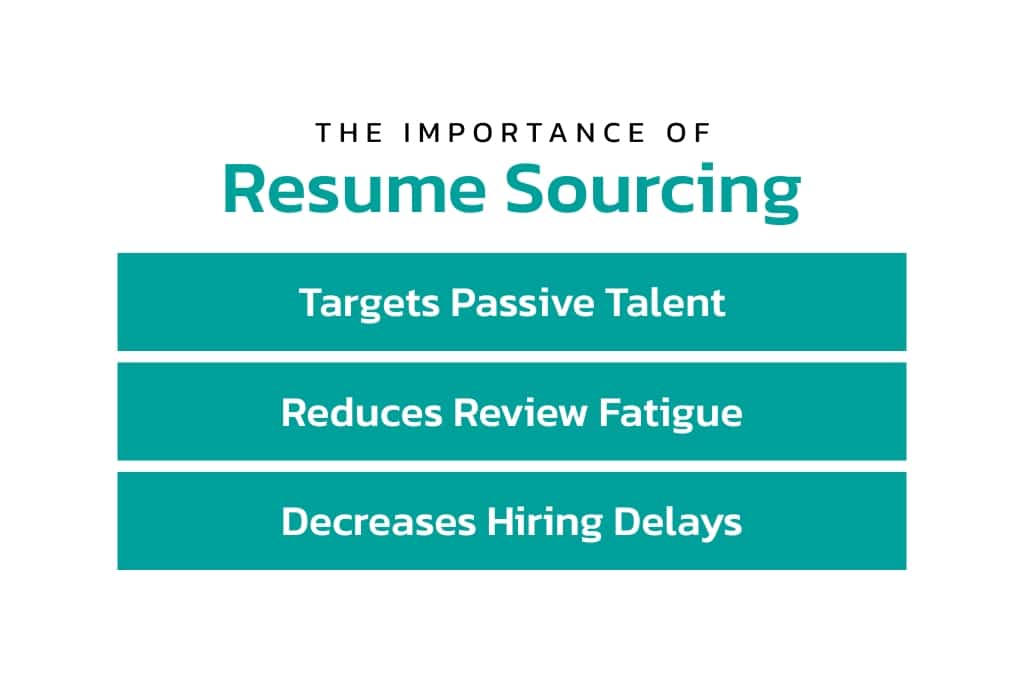
Passive Talent Remains Largely Invisible
Labor force participation in the U.S. has not fully rebounded to pre-2020 levels, even as job openings persist. Many qualified workers are employed but open to change. They are unlikely to apply without prompting. Resume sourcing is often the only way to reach them.
Application Volume Distorts Decision Quality
High applicant volume creates review fatigue. Recruiters move faster, not better. Sourcing narrows the field earlier, when attention is still available.
Hiring Delays Have Measurable Cost
LinkedIn analysis shows the average hiring process in the U.S. takes roughly 49 days, with specialized roles extending well beyond that. Every week spent searching increases vacancy risk, especially in operational roles.
Where Internal Resume Sourcing Commonly Fails
Most internal teams do not fail at sourcing because of effort. They fail because sourcing competes with everything else.
Recruiters are asked to source, screen, coordinate interviews, manage stakeholders, and report metrics. Sourcing becomes episodic rather than continuous.
Methodology also drifts. Search strings change. The criteria soften. Outreach quality varies by recruiter and by workload. Over time, outcomes become harder to explain or replicate.
Perhaps the largest blind spot is feedback. Many teams cannot connect sourcing decisions to later-stage outcomes such as interview performance or retention. Without that loop, improvement stalls.
How RPO Services Change Resume Sourcing in Practice
The value of RPO in resume sourcing is not scaled alone. It’s structure.
Dedicated Sourcing Ownership
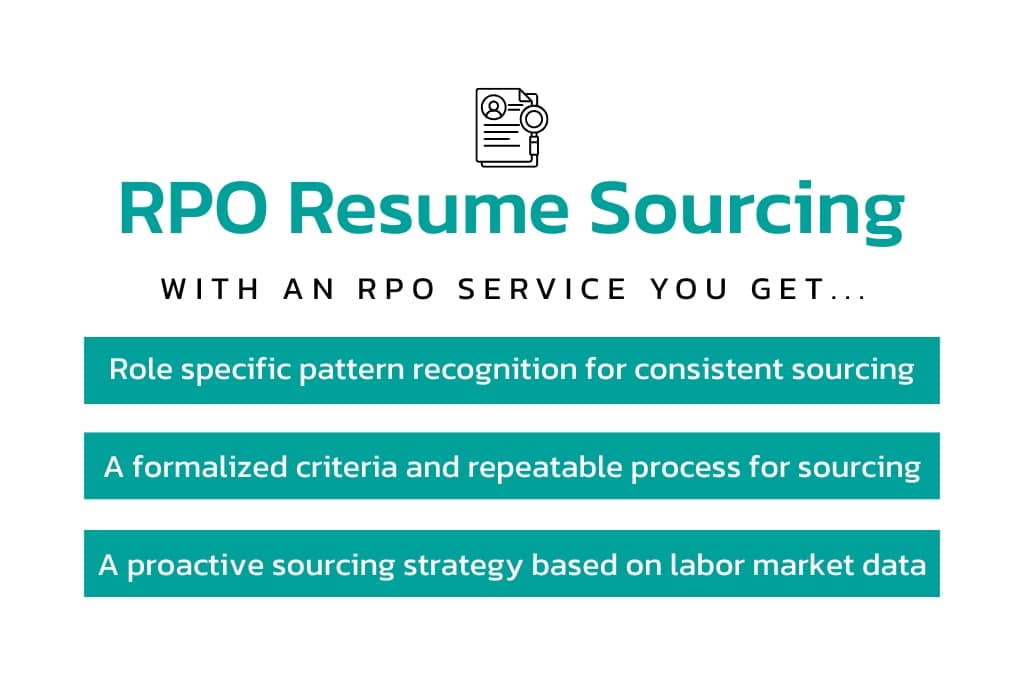
In an RPO model, sourcing is handled by specialists whose performance is measured on sourcing outcomes, not total requisition load. This creates consistency internal teams struggle to maintain.
Over time, these specialists develop role-specific pattern recognition that generalist recruiters rarely build.
Documented and Repeatable Sourcing Logic
RPO services formalize sourcing criteria tied to role families and labor conditions. Search parameters are tested, adjusted, and reused.
This does not eliminate judgment. It limits improvisation.
Market Signals Embedded Early
Advanced RPO models adjust sourcing strategy based on labor market data, including quit rates and regional hiring velocity.
Internal teams often react after pipelines dry up. RPO models adjust before that happens.
Resume Sourcing as a Workforce Planning Signal
One underused benefit of resume sourcing is forecasting.
Consistent sourcing activity reveals whether job requirements align with actual talent supply. It surfaces credential inflation, geographic constraints, and compensation misalignment early.
For example, sourcing for control technicians may show that PLC experience is no longer important. That insight can reshape role design before offers fail.
Most recruitment content ignores this planning value, yet it is where structured sourcing delivers disproportionate return.
Why Resume Sourcing Quality Matters More Than Volume Now
AI-assisted resume generation has changed the signal-to-noise ratio. Surface-level keyword matching is less reliable than it was even two years ago.
Recruiters are responding by tightening early sourcing criteria and increasing manual review earlier in the funnel. This shifts effort forward but reduces late-stage waste.
RPO-led sourcing absorbs that shift more effectively because sourcing capacity is not pulled away by interviews or stakeholder meetings.
Where WorkRocket Fits in This Model
At WorkRocket, we help carry out the actual sourcing of resumes rather than just acting as an advisor. Our sourcing workflows are designed to feed internal recruiters with documented, pre-qualified candidates rather than unfiltered resume lists.
During our process, we emphasize repeatability. For each role we ensure the criteria for the role is explicitly defined, trade-offs are acknowledged and your team remains in charge of the final decisions. With these guardrails set in place, we’re able to help you source high quality candidates without having to rethink the criteria every time.
For hiring managers, this leads to fewer interviews per hire. For HR teams, it shows up as more predictable hiring timelines.
Conclusion
Resume sourcing determines who enters the funnel and how much effort is wasted downstream.
Internal teams can execute it, but rarely with sustained consistency. RPO services improve results by stabilizing sourcing and keeping it separate from the other recruitment processes.
The organizations that struggle will be the ones without a disciplined way to decide which resumes matter.
