
On average, you’re spending around $30-60 per hour on your hiring staff. With each hour of work done, your cost per hire accumulates. Do you know what that cost is for your business? If not, this article will give you an idea of how to calculate it, how it compares to the national averages and give you suggestions to cut back on hiring time and costs.
SHRM’s Recruiting Benchmarking Report gives useful U.S. baseline benchmarks for both time to fill and cost per hire, split between executive and nonexecutive roles.
Here are the headline figures from that report:
- Average time to fill (nonexecutives): 56 days
- Median time to fill (nonexecutives): 44 days
- Average time to fill (executives): 57 days
- Median time to fill (executives): 45 days
And for cost:
- Average cost per hire (nonexecutives): $5,475
- Median cost per hire (nonexecutives): $1,200
- Average cost per hire (executives): $35,879
- Median cost per hire (executives): $10,625
Based on the data, executive hiring costs about 6.55x more than nonexecutive hiring on average.
The rest of the story lives inside the tasks.
Why Time to Fill Still Does Not Explain the Work
Time to fill measures elapsed days from requisition open to accepted offer. It helps a team answer, “How long did this take?”
It does not answer, “What did people spend their time doing?”
A hiring stage can take eight days on the calendar while only consuming a few hours of actual review. The remaining time often comes from waiting for inputs, chasing feedback, rescheduling interviews, and re-opening the shortlist after a late change in requirements.
That waiting creates labor. Someone writes the follow-up email. Someone answers the candidate’s “any update?” message. Someone re-books the interview that got bumped by a client call.
Time to fill and time spent on hiring tasks move together, but they are not the same thing.
Where Time Goes in the Hiring Process
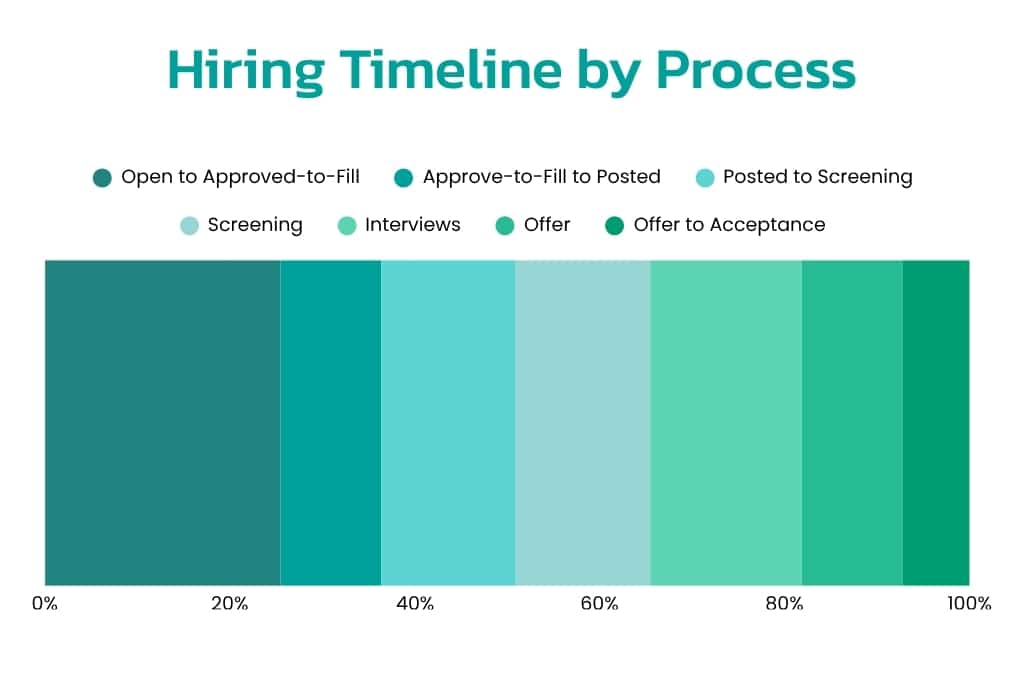
SHRM breaks nonexecutive time-to-fill into stages. This is the part many teams should tape to a wall. It shows where organizations typically lose days during the hiring process.
SHRM reports these average stage durations for nonexecutive hiring:
- Position open to approved-to-fill: 14 days
- Approved-to-fill to job posted: 6 days
- Job posted to screening started: 8 days
- Screen applicants: 8 days
- Conduct interviews: 9 days
- Make final decision and extend offer: 6 days
- Offer to acceptance: 4 days
Three points matter for anyone trying to improve hiring efficiency.
Approval Eats More Time Than Recruiting Work
The largest single block is open to approved-to-fill at 14 days.
That is not candidate sourcing time. That’s governance. Headcount review, budget alignment and internal prioritization.
A common pattern shows up in real organizations: the manager knows the role is needed, but the requisition sits because finance wants a quarterly review cycle. Recruiting cannot fix that with better messaging. This is an internal priority issue.
Screening Starts Later Than Most People Think
SHRM separates job posted to screening started (8 days) from screen applicants (8 days).
That first eight-day window is often a quiet process failure. Posting happens, then no one defines what “qualified” means, or the recruiter waits for volume, or the hiring manager takes a week to review the first shortlist.
A team can call this “screening,” but the calendar shows that this period of time is often a “waiting to start screening” period.
Interviews Are a Scheduling Problem in Disguise
SHRM reports the interview conducting process at 9 days on average.
Nine days rarely reflects nine days of actual interviewing. It reflects the coordination window: stakeholder calendars, reschedules, delayed feedback, and the slow drift from one round into another.
If hiring managers want faster hiring without lowering standards, interview efficiency should be one of the first points of review.
Average Time Spent on Core Hiring Tasks
Recruitment stage durations explain the overall time to fill. Core tasks explain why each stage takes so long.
This section focuses on three tasks that quietly expand timelines: resume review, interviewing, and offers.
Resume Screening Time
TheLadders Eye-Tracking Report states that recruiters spend an average of 7.4 seconds on a first-pass resume review.
At the same time, SHRM reports 8 days on average to screen applicants in the nonexecutive process.
That gap in time should show you the real problem.
The resume scan is quick. The workflow is slow.
Screening expands because it often includes:
- multiple passes after manager feedback
- disagreements about what “qualified” means
- rework when the shortlist gets rejected late
- documentation and dispositioning inside the ATS
- candidate communication that keeps the pipeline alive
Example: a recruiter sends five profiles, the manager rejects them with “not quite,” and no one can articulate the missing requirement. The team burns another week screening and re-screening for a problem that is still undefined.
Interview Time
Indeed’s Career Advice describes interviews commonly running 15 to 90 minutes with in-person and technical interviews commonly running between 45-90 minutes.
This matters because time-to-fill doesn’t capture how stakeholder time concentrates during interviews. One candidate might require multiple interviews across multiple stakeholders. Even when the interview itself lasts an hour, coordination and debrief can stretch the stage to days.
SHRM’s benchmark of 9 days for conducting interviews (for nonexecutives) reflects that operational reality.
Structured interviews can reduce the need for “one more conversation” because they increase consistency in how interviewers evaluate candidates. That reduces late-stage rework.
Offer and Decision Time
SHRM reports it takes 6 days to make a final decision and extend an offer, plus 4 days from offer to acceptance, on average for nonexecutive roles.
Many teams underestimate the time that this phase takes up because it feels administrative. It’s also where internal alignment failures show up.
A typical issue: compensation approval stalls because the team did not align early on range and leveling. The candidate waits. The recruiter spends time managing the relationship. The manager keeps asking for updates. The clock runs.
Executive vs Nonexecutive Hiring: Similar Days, Different Economics
SHRM’s average time to fill is close for executives and non-executives (57 vs 56 days).
While the time to fill is nearly identical, the cost per hire tells a different story:
- $35,879 average for executives
- $5,475 average for non-executives
This brings up two implications that matter.
Executive Hiring Carries a Long Tail
SHRM’s time-to-fill distributions show a higher upper range for executives, including a 75th percentile of 90 days for executive roles.
That tail is where executive hiring becomes expensive. Long searches require sustained sourcing, more stakeholder alignment, and more candidate management over time. Even if the median looks normal, the slow searches can dominate cost and attention.
Executive Hiring Uses More Expensive Time
Executive hiring tends to pull in senior stakeholders whose time carries higher opportunity cost. Executive processes usually require more coordination among decision-makers and more negotiation steps. Those activities sit inside the large cost-per-hire gap SHRM reports.
The practical point for a hiring manager is simple: executive hiring should be managed like a different product. It needs tighter alignment, earlier compensation clarity, and a more disciplined interview architecture in order to reduce cost.
Converting Task Time into Payroll Cost Using Federal Wage Data
To translate time into cost, use wage benchmarks and benefits data.
- Median wage for HR Specialists: $67,650 annually
- ≈ $32.52 per hour
- Median wage for Management Occupations: $116,880 annually
- ≈ $56.19 per hour
BLS also reports benefits account for 29.8% of total compensation costs for private industry workers.
Applying that adjustment:
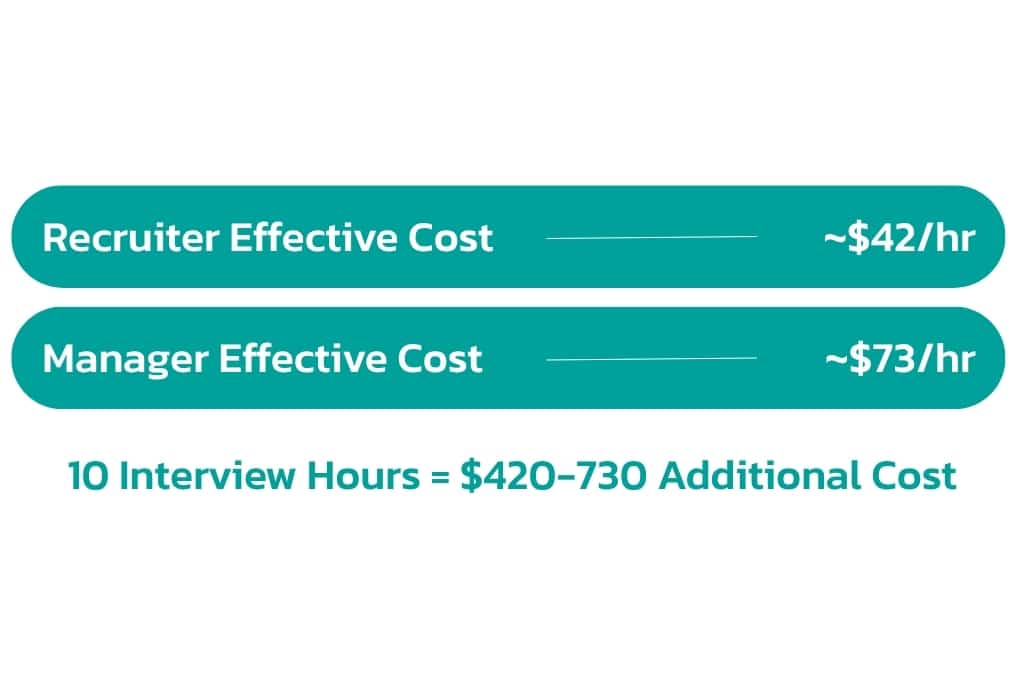
- Recruiter effective cost ≈ $42/hour
- Manager effective cost ≈ $73/hour
Even 10 additional interview hours across senior stakeholders equals:
10 × $73 = $730 in payroll time
Multiply that across multiple finalists and the cost expands quickly.
This is why “time spent” on each step of the process matters. A day lost to approval lag is not just a day. It triggers labor across recruiter coordination, manager follow-up, and candidate communication. Those costs accumulate in the background and appear later as cost per hire.
SHRM’s median and average cost-per-hire figures, especially the spread between them, strongly suggests wide variance across organizations.
Teams that want control over the cost of their hiring process need visibility into where their own time is going.
Internal Recruiting vs RPO: What Usually Changes and What Does Not
An RPO model can often improve:
- Screening start lag by running a tighter daily workflow
- Interview coordination through centralized scheduling discipline
- Candidate communication through consistent follow-up processes
An RPO model cannot solve:
- Open to approved-to-fill delays (14 days average), because that is internal governance
If approval is the bottleneck, an RPO will deliver candidates into a system that still cannot move. If interviews are the bottleneck, a well-run external operating model can reduce the amount of time spent on each core hiring task.
What Hiring Efficiency Means In 2026
Hiring efficiency is not about speed for its own sake. It is about reducing preventable waiting, rework, and drift.
SHRM’s stage data gives a benchmark map of where organizations typically lose time.
The fastest improvements usually come from three moves:
- Shorten approval cycles
- Start screening faster with a clear definition of “qualified”
- Treat interview scheduling and debrief as a planned workflow, not an afterthought
For companies looking to reduce their hiring costs or time to fill, use the SHRM data as the baseline, then measure where time spent on hiring tasks piles up inside your own process. Assess the processes you have in place and determine where you could save time with some small improvements to your process.
If you think your team could benefit from the help and structure of an RPO provider, reach out to the team at WorkRocket. We have a variety of services available to you that can help reduce both time-to-fill and cost per hire.
