
The skilled trades have been treated as a fallback or last resort option for years now and it’s resulted in something more than a labor shortage. It resulted in a complete shift of power in the hiring market for skilled trades.
92% of construction firms reported difficulty finding workers to hire, and 45% said labor shortages were causing project delays. Companies are now missing opportunities for business, pushing project timelines, and paying overtime just to keep up. If companies can’t attract the workers they need, project delays, extra expenses and lost opportunities will continue to build.
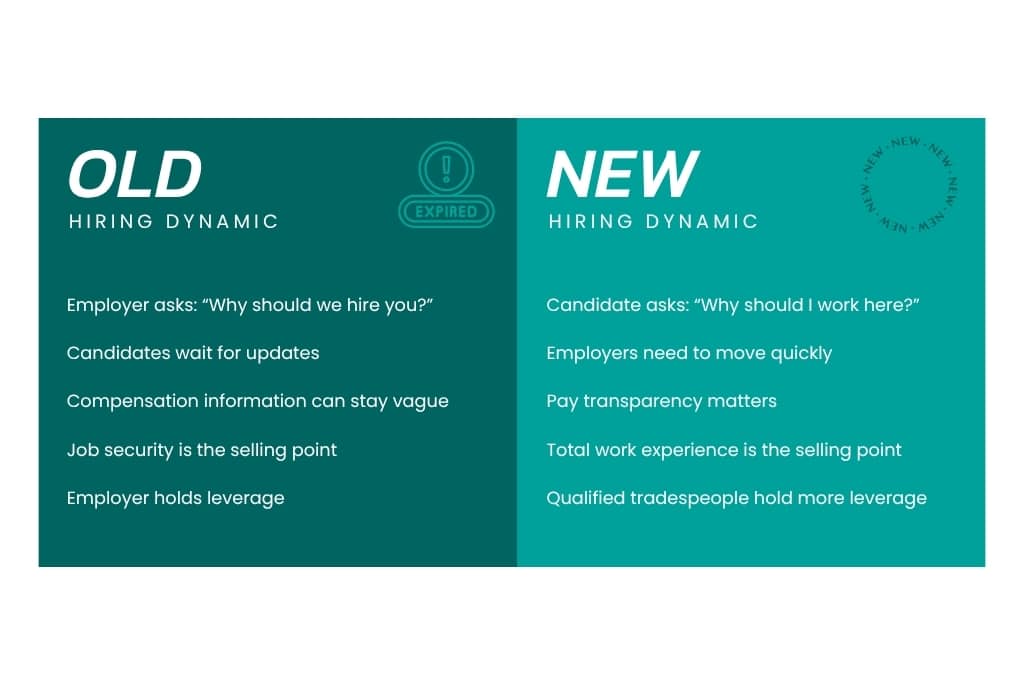
In a market like this, employers no longer hold the power in hiring conversation. Qualified tradespeople know what their labor is worth. Many already have jobs. Many can pick up overtime, take side work, follow a former supervisor, or move to a competitor that offers better pay, cleaner communication, safer working conditions, or a schedule that doesn’t wreck their life.
Instead of employers asking candidates. “Why should we hire you?” the candidates are now asking employers the important question: “Why should I work for you over the shop down the street?”
Table of Contents
The Power Dynamic in Trades Hiring Has Changed
Employers used to have more room to make candidates wait, guess, and prove themselves first. In a scarce labor market like skilled trades, employers can’t afford to do this anymore.
The construction market shows the pressure clearly. AGC and NCCER found that 92% of construction firms reported difficulty finding workers to hire, and 45% said labor shortages were causing project delays. The demand for workers isn’t slowing down either. Associated Builders and Contractors estimated that the construction industry needed to attract 439,000 net new workers in 2025 and 499,000 in 2026 to meet demand.
The manufacturing industry faces a similar long-term problem. Deloitte and The Manufacturing Institute estimated that manufacturers may need as many as 3.8 million workers between 2024 and 2033, with 1.9 million roles potentially going unfilled if workforce challenges continue.
Those numbers change the recruitment conversation. A welder, machinist, diesel mechanic, electrician, maintenance technician, CNC operator, HVAC technician, driver, or equipment operator may not feel desperate to move or rush their decision.
Skilled trades candidates are no longer just searching for an open role. Candidates now have more information, more options, and higher expectations around speed, flexibility, and transparency.
Compensation Is the First Employer Brand Signal
Compensation is often the first proof that an employer understands the market.
A job post that says “competitive pay” tells candidates almost nothing. Competitive compared to what? The shop down the road? Union wages? Local prevailing wage work? The overtime-heavy company that pays more but burns people out? The employer with lower hourly pay but better benefits and fewer weekend surprises?
Strong candidates want useful information. They want the hourly rate or salary range. They want to know how overtime works, whether overtime happens every week, whether shift differentials apply, how much benefits cost, whether travel time is paid, whether tools or uniforms are covered, and whether training leads to higher pay.
Indeed has reported that job listings with pay information receive about 30% more applications per click. Pay transparency won’t solve every hiring problem, but it removes guesswork from the first decision a candidate makes.
If the pay is strong, show it. If the total compensation package is better than the hourly rate alone suggests, explain it clearly. Paid training, certification support, per diem, a tool allowance, a company truck, steady hours, and a realistic path to higher earnings all matter.
A strong employer brand in the trades starts with the offer because the offer tells workers whether the company respects their time and effort.
Flexibility in the Trades Means Control Over Time
Flexibility gets misunderstood in trades hiring because too many people define it through office work. A field technician can’t repair equipment from a kitchen table. A machinist can’t run a CNC machine remotely. A welder, installer, driver, mechanic, or electrician usually needs to be where the work is.
That doesn’t make flexibility impossible. It makes the definition different.
In the trades, flexibility often means predictable start times, fewer last-minute schedule changes, shift options, compressed workweeks where possible, better notice before weekend work, PTO that people can actually use, paid travel time, local route consistency, and overtime that doesn’t become the default business model.
Candidates don’t just want a job that pays well. They want a job that respects their time and allows for predictable schedules and work life balance.
Will they see their kids during the week? Can they plan around childcare? Will every Friday turn into a surprise Saturday? Will the company respect PTO, or will time off become a fight? Will “occasional overtime” really mean 55 hours every week?
Younger workers want a career that gives them a future without swallowing their entire life.
Not every company can offer four-day weeks or perfect schedule control, but many can still offer more predictability, cleaner communication, and fewer avoidable disruptions. That counts too.
Work Environment Is What Skilled Trades Candidates Actually Judge
Skilled trades candidates evaluate the work environment through the daily reality of the job.
They notice whether the trucks are maintained. They care whether tools are in good condition. They ask whether machines break down because preventive maintenance gets ignored. They want to know whether the supervisor understands the work or only pushes harder when jobs go sideways. They also watch how seriously the company treats safety.
A shop with broken equipment, constant chaos, ignored safety concerns, and burned-out leads tells candidates that the work environment is filled with neglect and a lack of concern for their employees.
When a company has organized jobs, reliable equipment, responsive supervisors, and workers who seem like they’re treated with basic respect, candidates can imagine a much more enjoyable daily life in their work environment.
Training and Advancement Prove the Employer Is Worth Choosing
A skilled trades job becomes more attractive when candidates can see where it leads.
Not every worker wants to become a manager, but some want to become better technicians. Some want higher-level certifications. Some want to learn programming, diagnostics, controls, hydraulics, robotics, estimating, project coordination, or crew leadership. Some want a path from helper to lead, apprentice to journeyman, operator to supervisor, or technician to service manager.
The stronger employer brand makes that path visible.
Paid certifications, mentoring, cross-training, tuition support, CDL support, welding certification support, CNC programming exposure, or manufacturer-specific equipment training all tell candidates the company has a future to offer.
Public Image Reaches Candidates Before Recruiters Do
Trades candidates often know more about a company than employers realize.
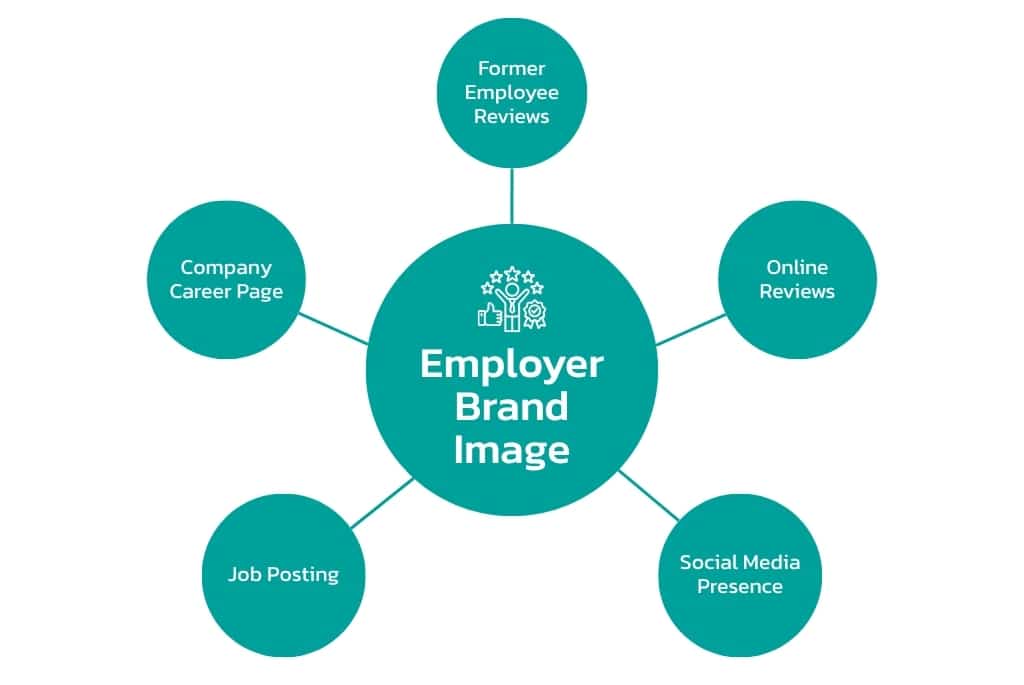
They hear things from former employees. They ask around. They notice company trucks. They see how crews act on jobsites. They read reviews. They look at social media. They judge job posts. They check whether the careers page looks current or abandoned.
That public image can help or hurt before a recruiter ever makes contact.
A company doesn’t need to look perfect, but it does need to look credible. Real employee photos usually beat stock images. Specific job details beat generic phrases. Clear pay information beats “competitive compensation.” A short explanation of training beats “room for growth.” A real description of the schedule beats “fast-paced environment.”
Candidates are trying to reduce risk. They’re asking whether the company will be better than where they are now, or just different.
A strong careers page gives employers a place to show the real employee value proposition before candidates apply.
Candidate Experience Is Part of the Sales Pitch
The hiring process tells candidates how the company operates.
If the process is slow, vague, disorganized, or dismissive, candidates may assume the workplace works the same way. That assumption may not always be fair, but it’s common. Strong candidates don’t have much reason to wait while an employer figures out how to communicate.
CareerPlug’s 2024 Candidate Experience Report found that 76% of candidates said a positive candidate experience influenced their decision to accept an offer. It also found that 52% of job seekers had declined an offer because of a poor experience with a potential employer during the hiring process.
If one company responds the same day, gives a clear pay range, explains the schedule, answers questions directly, and moves quickly, that company feels easier to trust. If another company takes a week to respond, hides the pay, adds unnecessary steps, and gives vague answers about overtime, the candidate may walk before the employer gets a real chance.
The hiring process should make the opportunity stand out as an easy choice. It shouldn’t make the candidate work harder to understand it.
How Trades Employers Can Build a Brand Candidates Take Seriously
A stronger trades employer brand comes from proof. The company has to show candidates what makes the job worth considering.
The most useful details are usually the most practical ones:
- Clear pay range
- Overtime expectations
- Shift options
- Benefits and employee cost
- Travel requirements
- Tool, uniform, truck, or equipment support
- Safety practices
- Supervisor expectations
- Training opportunities
- Advancement paths
- Real employee stories
- Photos or videos of real work environments
- Applicant response timelines
- Specific reasons someone should leave another employer for this one
Candidates just need enough clarity to decide whether the trade-off makes sense. A role can involve hard work, early mornings, seasonal overtime, travel, or physically demanding conditions and still be attractive if the pay, respect, training, safety, and communication are strong.
The problem occurs when employers ask candidates to accept hard work without giving them a clear reason to believe the company deserves their effort.
Where WorkRocket Fits into Skilled Trades Employer Branding
When candidates have leverage, employers need stronger messaging and a better way to reach the right people. A generic job post won’t carry enough weight on its own, especially when the best-fit candidate may already be employed.
WorkRocket helps employers turn the real strengths of the job into clearer recruitment marketing, stronger job messaging, better candidate outreach, and a more consistent hiring process.
That can include communicating compensation, schedule expectations, training opportunities, advancement paths, work environment, and company reputation in a way candidates can actually use.
With WorkRocket, the goal is to make a strong opportunity visible, specific, and easier for qualified candidates to trust. Reach out to our team today to discuss a strategy to improve employer branding and hiring outcomes for your skilled trades business.
