
Employer branding is often viewed as reputation management. Companies can talk about visibility, social content, employee stories, and career pages but what good does that do if you don’t know how to measure success from these efforts?
The question that really matters is: does your employer brand make qualified candidates more likely to trust the company, move through the process, and accept the job? If it doesn’t and trust weakens, hiring usually gets worse before leadership notices. The damage often starts as lower conversion, weaker referrals, more candidate hesitation, and heavier dependence on paid channels long before roles become obviously hard to fill.
So how do you assess your employer brand before it becomes an issue? Glassdoor points employers toward metrics such as application rates, cost per application, click-through rates, and candidate quality by source instead of relying on awareness alone.
Table of Contents
Why Application Volume Is a Weak Employer Brand KPI
Application volume is easy to track, but it is a poor standalone measure of employer brand strength because it tells you almost nothing about candidate confidence.
A company can attract plenty of applicants for reasons that have little to do with brand strength. It may have a well-known name, a large hiring footprint, aggressive job-board distribution, a hot labor market location, or roles that draw a high number of underqualified applicants. None of that proves that candidates trust the employer. It only proves they saw the opening and took some level of interest.
High volume can coexist with a weak employer brand. Candidates may click but not apply. They may apply but disengage early. They may interview, then back out because the company feels less credible, less organized, or less appealing than alternatives.
CareerPlug’s 2025 Recruiting Metrics Report shows how misleading applicant totals can be. Across more than 60,000 small businesses and more than 10 million applications, employers averaged 180 applicants per hire but invited only 3% of applicants to interview and converted 27% of interviews to hires.
Those numbers describe a funnel where large numbers at the top often fail to translate into real hiring progress. That matters for employer-brand measurement because weak brand strength usually shows up first as poor conversion and low-confidence behavior, not as a dramatic drop in total applications.
Awareness and Brand Strength Are Not the Same Thing
Employer brand awareness tells you whether candidates know you exist. Employer brand strength tells you whether they believe what they see enough to keep moving.
Hiring outcomes depend far more on trust than on exposure alone. A company can have strong reach and still have a weak employer brand in recruiting terms. Candidates may recognize the name, see the openings, and visit the company profile, but still hesitate because reviews are worsening, employee advocacy is weak, or the hiring process feels disorganized.
Glassdoor reports that 83% of job seekers are likely to research company reviews and ratings when deciding where to apply, 70% of Glassdoor users are more likely to apply if the employer is active on the platform, and 71% improve their perception of a company when it responds to reviews.
Candidates are going to be aware of your employer reputation regardless of it being strong or weak. Awareness with a weak employer brand can ultimately cause more hiring issues. Awareness with a strong employer brand can lead to a healthy hiring pipeline that people desire to be a part of. The actions you take to manage your employer brand are what lead you to success or failure in your hiring process.
Career-Site Conversion Rate
Career-site conversion rate is one of the clearest employer-brand KPIs because it sits between curiosity and commitment.
When candidates visit job pages but don’t convert, something is weakening the handoff between interest and action. Sometimes that problem is a technical issue such as a clunky application flow or weak mobile experience. But it can also point to a branding issue. Candidates may be landing on the role and deciding that the employer doesn’t look trustworthy, the opportunity does not match the promise, or the messaging feels too vague to justify the time investment.
That is why Glassdoor recommends tracking job application rates, cost per application, and CTR for branded vs. non-branded channels.
A strong employer brand should make direct interest more productive. People who already know the company or deliberately seek it out should convert at a healthy rate because they arrive with some level of confidence. If branded traffic on your careers page is slowing down, it may be a sign that candidates are losing confidence in your brand.
Apply-Start to Apply-Completion Rate
This KPI matters because it shows what happens after initial interest but before real commitment.
If candidates start applications and fail to finish them, there’s a chance the application is just too long; but that’s not the only possibility. Candidates often abandon applications because they started with mild interest and then lost confidence once they looked more closely at the employer, the role, the requirements, or the process.
That makes the apply-start to apply-completion rate useful because it captures hesitation in a way raw application totals can’t. A low completion rate could be a signal that your application process is too complex or that a growing share of candidates don’t believe the opportunity is compelling enough to finish.
Review Trends Matter More Than Review Scores Alone
With Glassdoor reporting that 83% of job seekers are likely to research company reviews and ratings, reviews are an important part of your employer brand. Monitoring them can give you valuable insights into ways to improve the overall quality of the candidate experience with your company.
Indeed says job seekers spend about 25% of their time on an Indeed Company Page reading reviews. They recommend monitoring those reviews for recurring patterns and using them to guide workplace changes.
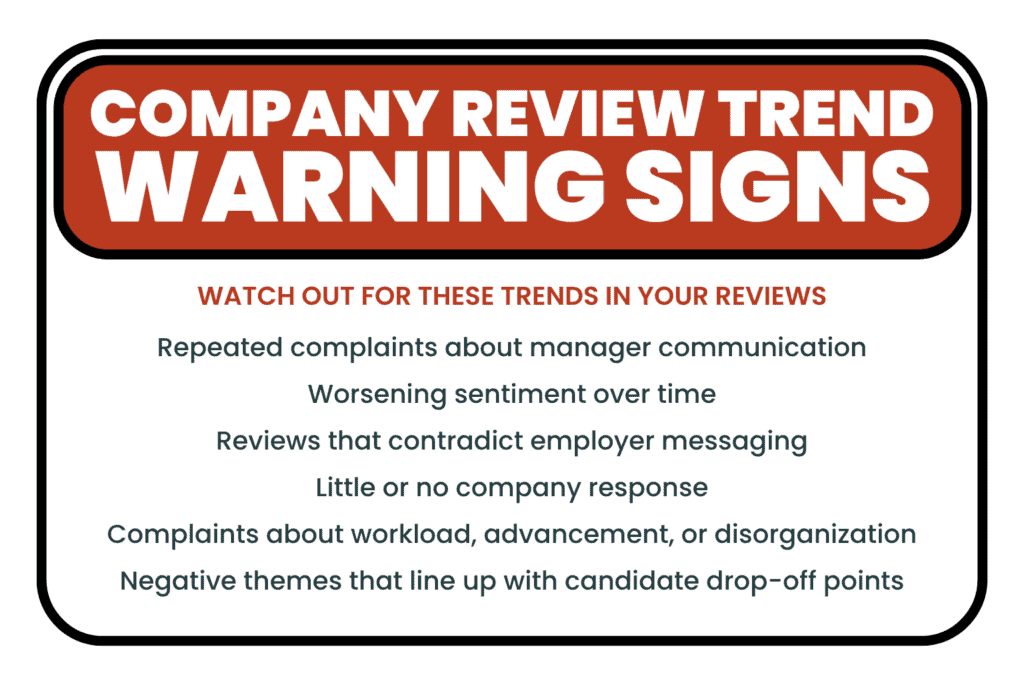
The most useful review signals are usually:
- Repeated complaint themes
- Worsening sentiment over time
- A gap between employer messaging and employee descriptions
- Lack of response from the company
- Complaints that line up with candidate drop-off points
The important thing to understander is that those reviews are teaching candidates what to expect from your company. If multiple reviews mention poor manager communication, internal disorganization, unclear advancement, or unrealistic workloads, candidates read those reviews as warnings about what daily life in the company may feel like.
If you start seeing a negative trend in your reviews, take the time to read through them carefully and respond to and address the issues that were brought up. Create a plan to assess the ongoing issues you may have, then figure out how to implement changes that will resolve them.
Referral Applicants and Hires
Internal referrals are one of the strongest employer-brand indicators because they measure your employer brand from the inside.
Employees don’t refer people simply if they don’t believe the company is a place worth attaching their own name and reputation to. That makes referrals a form of lived employer-brand endorsement.
CareerPlug’s 2025 report found that referrals account for 2% of applicants but 11% of hires, while careers pages account for 13% of applicants but 26% of hires. By contrast, job boards produce 61% of applications but 42% of hires.
The data shows us that referrals produce a significantly higher ratio of hires to applicants compared to careers pages and job boards. When candidates hear about the opportunity from a trusted source, they’re more likely to have confidence and trust in the employer and pursue the job.
A declining share of referrals can matter even when your current hiring volume looks stable. It may be one of the earliest signs that employees are becoming less willing to advocate for the company, which often shows up before external perception of the company collapses.
Candidate Response Rate and Ghosting
Ghosting is often treated as proof that candidates are flaky or unserious, but there are many other reasonable explanations for this as well.
Candidate silence can signal weak employer pull. If outreach response rates fall, if scheduled interviews get skipped more often, or if candidates disappear after early conversations, the issue may be that the company is not generating enough trust, urgency, or value to hold their attention.
Not every instance of ghosting is a brand problem; some of its competition or simple personal disengagement. The point is that employers shouldn’t assume ghosting has nothing to do with them. Candidates compare opportunities quickly, and companies that feel slow, vague, impersonal, or hard to read often lose momentum without receiving explicit feedback.
CareerPlug’s 2024 Candidate Experience Report found that 76% of candidates said a positive experience influenced their decision to accept an offer, while 52% said they had declined a job offer because of a poor experience during the hiring process.
Candidates are paying close attention to the employer’s behavior during these initial interactions. Their perception of the people they speak to early on often forms their opinion of the brand as a whole. If communication feels weak, scheduling is messy, or the process suggests low respect for the candidate’s time, the employer brand becomes less credible.
Offer Acceptance Rate
Offer acceptance is one of the clearest downstream employer-brand KPIs because it answers a simple question: when qualified candidates reach the point of decision, do they believe enough in the employer to commit?
A weak acceptance rate doesn’t automatically mean the employer brand is failing. Compensation, timing, role fit, manager quality, and competitive offers all matter. But when a declining acceptance rate combines with other signals such as declining referral share, worsening review trends, higher candidate ghosting, or weaker career-site conversion, there may be deeper issues.
Acceptance rate is a useful late-stage KPI that can help confirm whether or not earlier trust signals are turning into consequences. Once acceptance rate begins to falls, the brand may already be facing issues with pay expectations, candidate caution, and a weaker overall impression of the employer.
How To Tell Whether the Problem Is Your Brand, Process, or Sourcing
Sometimes these issues are a result of sourcing and sometimes their a result of a negative employer image.
If a company is attracting the wrong candidates from the wrong channels, the issue may be targeting or job-distribution strategy. But if you’re spending more while direct traffic weakens, referrals shrink, review sentiment deteriorates, and candidates become less responsive, that pattern points to a broader issue. Candidates aren’t perceiving you as a desirable employer.
A useful way to separate the problems is to look at where the problem starts.
If the weakness shows up before candidates meaningfully engage, such as low direct apply rates, weaker interest in your brand, or hesitation tied to your reputation, the issue is more likely employer brand.
If interest starts strong but falls apart during scheduling, interviewing, or post-interview communication, the issue may be more candidate experience driven.
If applicant volume is high but the candidates are poor fits from the beginning, the issue may be channel quality, job clarity, or sourcing mix.
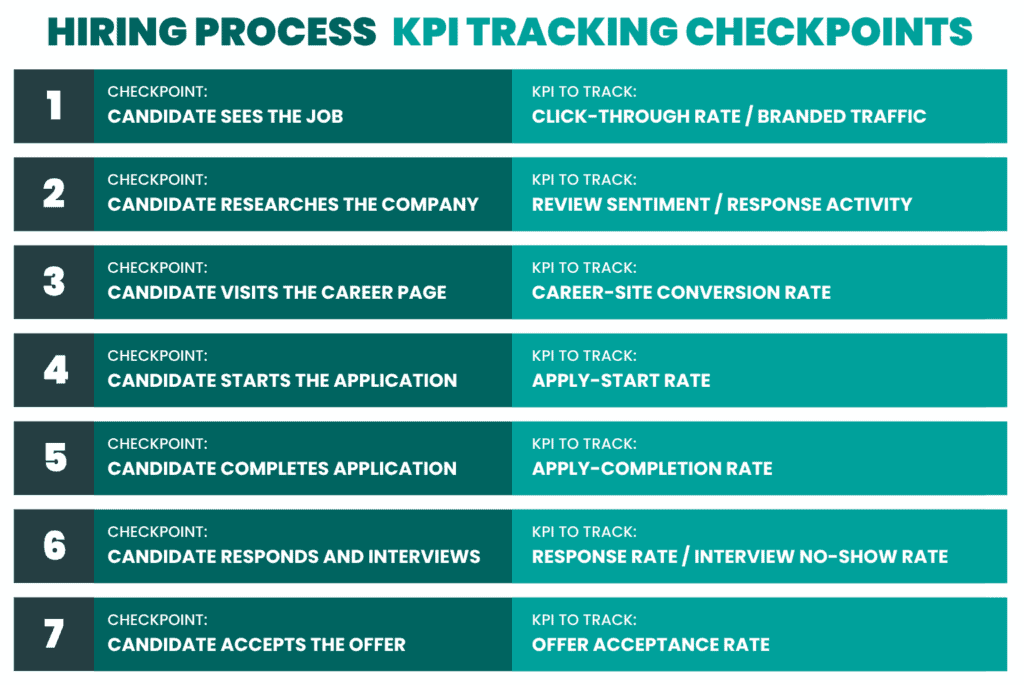
A Practical Employer Brand KPI Dashboard
A useful employer-brand dashboard should track patterns across visibility, trust, conversion, advocacy, and efficiency.
For most employers, that means watching:
- Career-site conversion rate
- Apply-start to apply-completion rate
- Review sentiment trend
- Review-response rate
- Referral percentage of applicants and hires
- Direct-applicants vs paid-channel applicants
- Candidate response rate after first contact
- Interview no-show rate
- Offer acceptance rate
- Candidate interview offers by source
- Cost per application by branded and non-branded channels
The reason this mix works is that it captures the full path from attention to commitment. Visibility metrics show whether people are finding the employer. Trust metrics show whether the employer’s reputation holds up under scrutiny. Funnel metrics show whether interest turns into action. Source and efficiency metrics show whether the company is depending too heavily on paid distribution to maintain results.
No single KPI proves employer brand strength. The value comes from what the metrics say together.
At WorkRocket, we help companies across various industries improve their employer branding with our RPO services. Contact our team to discuss the best approach for your business.
