
TL;DR
Contingency search is usually best when an employer wants low upfront commitment and is hiring for roles with a broader talent pool.
Retained search is usually best when the role is high-stakes, confidential, or difficult to fill and the employer needs deeper search ownership.
RPO is usually best when the employer needs recurring recruiting capacity, process support, or scalable hiring infrastructure rather than help on just one role.
Most employers misread recruiting fees because they compare prices before they compare scope. The real questions to ask when comparing search models are:
- What kind of hiring problem is the company trying to solve?
- How much internal burden does it wants to keep?
- How expensive would a delay or failure be?
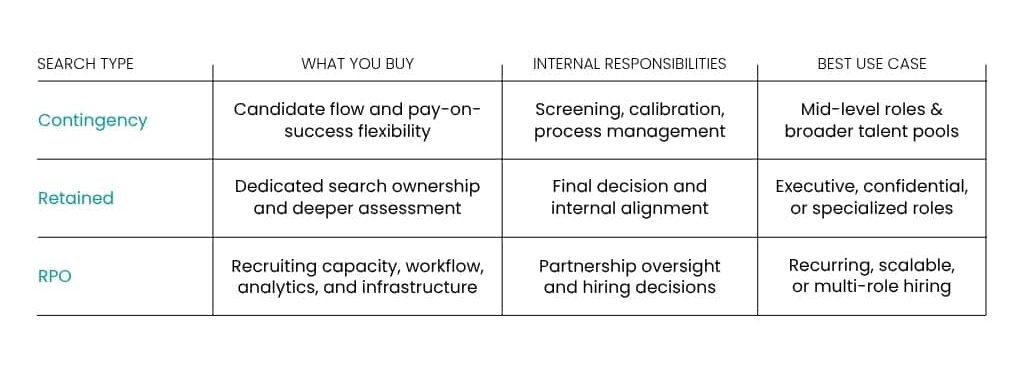
Table of Contents
Why Employers Misread Recruiting Fees
Price & Value Are Not the Same Thing
A lower fee doesn’t always mean a lower hiring cost. It can simply mean the employer is keeping more of the work in-house. That may be fine when the role is straightforward and the internal team has the capacity to handle it but it becomes expensive when hiring managers end up doing heavy screening, the process drags, or the search never reaches the right talent pool.
What A Recruiting Fee Can Actually Buy
A recruiting fee can buy very different things. It may buy sourcing reach, recruiter time, exclusivity, assessment rigor, market mapping, candidate management, employer-brand support, analytics, or broader recruiting capacity. Once it’s clear what you’re actually buying with the fee, pricing differences make more sense because the employer is no longer treating very different services like interchangeable commodities.
Why the Wrong Comparison Leads to Bad Budgeting
When employers compare only fee percentages, they miss the real budgeting issue. The real choice is whether they’re buying candidate introductions, a managed search, or recruiting infrastructure. If they buy the wrong one, the apparent savings often disappear into slower hiring, more internal labor, and weaker outcomes.
Contingency vs Retained vs RPO: What Money Buys In Real Terms
| Search Type | What The Employer Pays For | What Stays Internal | Where It Delivers Best Value | Best Budget Fit |
| Contingency | External sourcing, candidate flow, pay-on-success flexibility | More screening, calibration, and process management | Mid-level roles, broader talent pools, lower-stakes searches | Tight upfront budgets, variable hiring budgets, opportunistic hires |
| Retained | Exclusive search ownership, deeper intake, stronger assessment, passive candidate access | Final hiring decision and internal alignment | Executive, confidential, specialized, or high-impact roles | Strategic role budgets, executive budgets, high-cost-of-failure budgets |
| RPO | Recruiting capacity, process consistency, analytics, workflow support, scalable infrastructure | Oversight of the partnership and internal decisions | Recurring hiring, growth ramps, multi-role or multi-location hiring | Operating budgets, annual hiring plans, scalable workforce budgets |
What You’re Buying with Contingency Search
What Contingency Pricing Usually Covers
Contingency search usually buys external sourcing, candidate presentation, and pay-on-success flexibility. There is little or no upfront commitment, and the recruiter is only paid if a hire is made. AESC describes contingent recruiters as firms hired to present candidates who fit the client’s criteria, with much of the assessment and selection work left to the client.
What Employers Usually Do Not Buy with Contingency
Employers usually aren’t buying guaranteed exclusivity, deep advisory work, broad market mapping, or a highly structured evaluation process with contingency search. A strong recruiter may provide some of that, but it’s not the core economic design of the model. The low upfront commitment that makes contingency attractive also limits how much dedicated search ownership the employer should expect.
When Contingency Provides the Best Value
Contingency tends to provide the best value when the role is mid-level, the talent pool is broad enough, and the employer mainly needs more candidate flow. AESC explicitly ties contingent recruiting to mid-level positions or positions with a larger pool of qualified candidates. It also works best when the internal team can handle real screening and process management.
Best Budget Types for Contingency
Contingency usually fits cash-constrained budgets, approval-sensitive budgets, and variable hiring budgets. It works for one-off hires, uncertain headcount plans, and situations where leadership wants optionality more than process certainty.
Where Contingency Becomes Expensive in Practice
Contingency becomes expensive when employers mistake low upfront cost for low total cost. If the role is difficult, confidential, or hard to calibrate, the company may absorb more screening burden, more coordination burden, and more delay than expected. AESC notes that contingent recruiters generally work many assignments at once and are paid only on successful placement, which affects how much sustained attention a stalled search is likely to receive.
What You’re Buying with Retained Search
What Retained Pricing Usually Covers
Retained search usually buys exclusive search ownership, deeper intake, more formal candidate assessment, and a more consultative process.
Why Retained Search Costs More Upfront
Retained search costs more upfront because the employer is buying dedicated capacity and deeper work. AESC says retained firms are engaged in all aspects of the search, from defining the search through candidate integration, and often use more rigorous assessment methods. The fee is higher because the service is broader and more controlled.
When Retained Search Provides the Best Value
Retained search provides the best value when the role is senior, high-impact, confidential, or hard to fill. Retained executive search is typically used for senior-level executive positions and board directors, especially where the best candidate is harder to find and harder to persuade to move. The higher upfront fee can still be the better value if the cost of failure is high enough.
Best Budget Types for Retained Search
Retained search fits strategic hiring budgets, executive search budgets, and any budget where delay or failure is more expensive than the fee. It works well for succession planning, leadership replacement, transformation roles, and searches where the company wants one accountable partner with stronger diligence.
Where Retained Search Can Be Poor Value
Retained search can be poor value when the role is straightforward, the candidate market is broad, or the internal team can fill the job effectively on its own. It’s also less reasonable when the real problem is recurring hiring demand across many roles rather than one critical search.
What You’re Buying With RPO
RPO Is Not Just Another Recruiting Fee Model
RPO is usually not a simple third option besides contingency and retained search. Buyers increasingly want consultative guidance, workforce insights, technology-enabled hiring models, and modular or project-based RPO structures. RPO can help companies determine how hiring should be run, measured, and optimized.
What Employers Are Really Paying for In RPO
In RPO, employers are usually paying for recruiting capacity, process consistency, technology support, analytics, and scalable execution across a broader part of the hiring function. RPO is often used as an alternative to internal talent acquisition buildouts, fragmented agency spend, or underpowered recruiting operations.
When RPO Provides the Best Value
RPO provides the best value when hiring is recurring, multi-role, multi-location, or process heavy. It’s strongest when the company’s problem is not just sourcing candidates but running a reliable hiring engine.
Best Budget Types for RPO
RPO usually fits operating budgets, planned annual hiring budgets, and recurring workforce budgets. It works best where leadership wants predictable recruiting capacity, cleaner metrics, and a more deliberate hiring system.
Where RPO Can Be Poor Value
RPO can be poor value when the employer only needs one or two hires, especially at the executive level, or when hiring volume is too low to justify broader process infrastructure.
Which Search Model Fits Different Budgeting Strategies
Best For the Tightest Upfront Budgets: Contingency
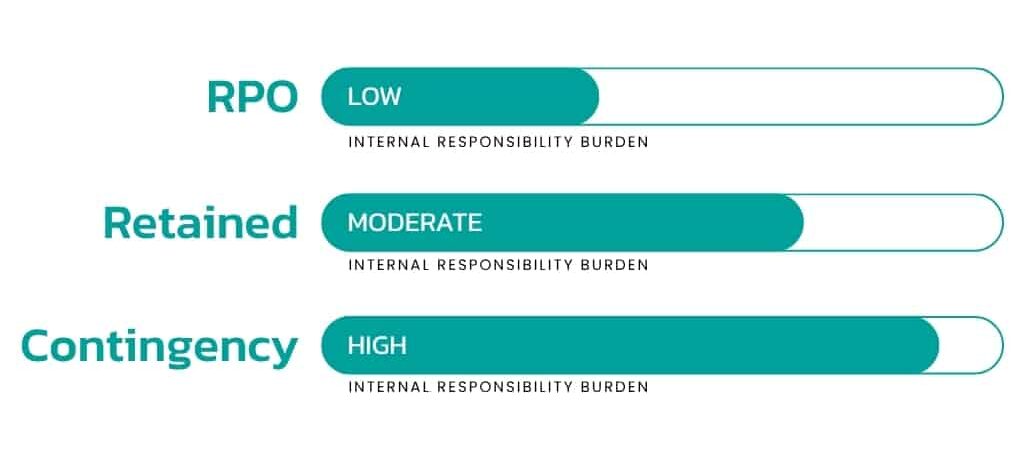
Contingency is usually best when the company wants outside recruiting help without early financial commitment. It preserves cash and reduces approval friction, but often leaves more of the process burden inside the business.
Best For High-Risk, High-Cost-Of-Failure Budgets: Retained
Retained search is usually the better fit when a weak hire, slow search, or confidentiality breach would be expensive. In those cases, buying diligence and search ownership is often smarter than optimizing for the lowest visible fee.
Best For Recurring or Scalable Budgets: RPO
RPO is usually the strongest fit when hiring is an ongoing operating need. It makes sense when leadership wants more predictable recruiting capacity, better process visibility, and cleaner execution over time.
Best For Mixed Budgeting Environments
Many employers will need to use more than one model for their hiring needs. A practical setup is retained search for executive hires, contingency for occasional mid-level openings, and RPO for recurring hiring programs or project ramps.
Questions to Ask to Decide Which Hiring Model Provides the Most Value
Ask How Much Search Ownership You Need
If the company mainly needs resumes and can screen well internally, contingency may be enough. If it needs a more managed process with deeper evaluation, retained search is usually a better fit. If it needs broader recruiting execution and infrastructure, RPO is often the more accurate solution.
Ask How Expensive Delay & Failure Would Be
The higher the cost of a prolonged vacancy or a bad hire, the less useful a price-only comparison becomes. That is especially true for executive roles.
Ask What Your Internal Team Can Realistically Absorb
Many employers assume they’re buying more recruiter ownership than they actually are. The result is that internal recruiters, HR leaders, and hiring managers carry the screening, coordination, and calibration work themselves.
Ask Whether Your Budget Is Transactional, Strategic, or Operational
A transactional budget usually points toward contingency. A strategic role budget usually points toward retained search. An operational capacity budget usually points toward RPO.
Final Takeaway
The cost of contingency, retained, and RPO services shouldn’t be the main focus when assessing which search type will work best for you. Instead, look at the type of role you need filled, your ongoing needs, the type of budget you’re working with and the amount of work your internal team is able to absorb. Once you’ve defined these things, the search type that provides the most value will become clearer.
If you think your team may be able to benefit from an RPO service, reach out to the team at WorkRocket to discuss the services we offer. If you’re leaning towards retained or contingency searches, our partners at The Richmond Group USA may be able to assist you.
