
The labor market these days punishes employers that move slowly, communicate poorly, or rely on a recruiting function held together by hustle and follow-up emails. Within a competitive labor market, the quality of your hiring process determines the quality of talent you get.
This is where RPO comes into the conversation. Many leadership teams are looking at the same symptoms and realizing the issue may not be recruiting effort alone. It may be that the hiring process itself has stopped working reliably.
A company usually doesn’t need an RPO provider just because they have roles that need to be filled. It usually needs RPO when the hiring system starts producing the same preventable failures repeatedly. Requisitions open late. Hiring managers take too long to review candidates. Candidates wait for updates that never come. Recruiters spend more time chasing decisions than evaluating talent.
HR.com’s 2025 research found that 51% of organizations still rely on reactive, just-in-time hiring, Many employers are still running a modern hiring burden through a process that was never designed to carry it.
Once hiring becomes erratic, managers stop trusting timelines, vacancies stay open longer, teams carry extra workload, and candidates begin to read the process as a preview of the company itself. At that point, RPO becomes more than a staffing solution; it becomes a way to safeguard your employer brand while being proactive about your hiring needs.
Busy or Broken? Identifying Issues in the Hiring Process
Busy & Broken Are Not the Same
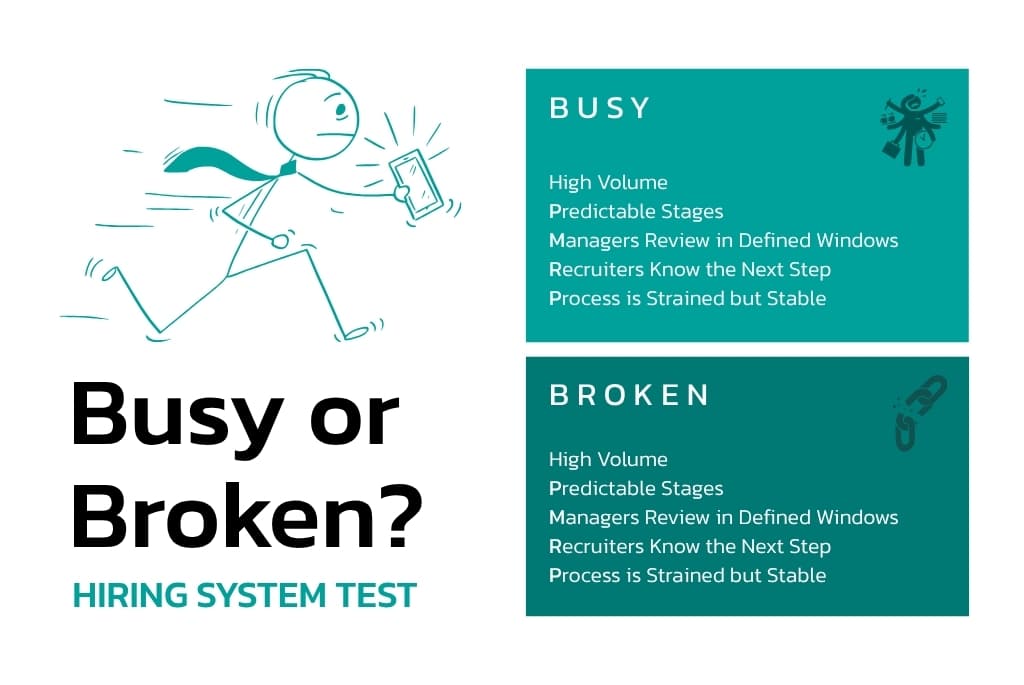
A busy hiring function may be stretched, but it still behaves predictably. Candidates move through stages on time. Managers review profiles within a defined window. Recruiters know what happens next. Metrics may not be perfect, but the machine works.
A broken hiring function feels different. Roles stall for reasons no one can clearly explain. Candidates drop because communication slows down. Hiring managers treat reviews as optional. Recruiters start acting like project managers for everyone else’s indecision. The work still gets done sometimes, but only because a few people are constantly patching leaks.
That’s the difference. Busy means strained. Broken means unreliable. RPO can help both.
Why Reactive Hiring Is Dangerous
When a company only hires once the business needs become urgent, the recruiting process starts late and under pressure. Intake gets rushed. Hiring managers give vague requirements. Recruiters are told speed matters most, but decision-makers still move slowly. By the time candidates enter the pipeline, everyone is already working behind schedule.
If 51% of organizations remain in reactive, just-in-time mode, then many hiring slowdowns are not random at all. They are baked into the way demand enters the system.
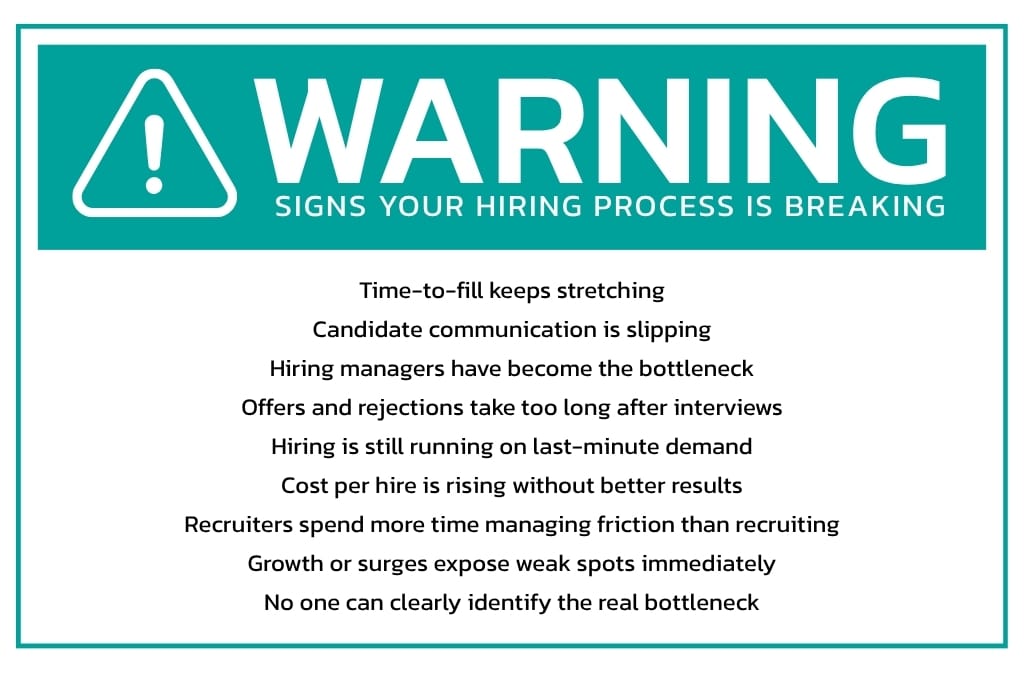
9 Warning Signs Your Hiring Process Is Breaking
1. Time-To-Fill Keeps Stretching
SHRM defines time-to-fill as the time between opening a requisition and accepting an offer. One role taking longer than expected isn’t the issue. The problem is a pattern. If time-to-fill rises across departments, sites, or job families, the process is accumulating friction faster than the team can remove it.
That friction can sit almost anywhere: approvals, sourcing, scheduling, manager review, compensation signoff, or offer processing. The number alone does not diagnose the issue, but it is often the first signal that something in the system has started dragging.
2. Candidate Communication Is Slipping
Candidate communication is often treated as optional when in reality; it’s one of the clearest operational indicators in recruiting.
SHRM’s summary of Talent Board’s research found that top reasons candidates withdraw include poor communication, lack of feedback, and processes that take too long. In the U.S., 36% of candidates said they still had not heard from employers one to two months after applying. This is unchanged from the previous year signaling that hiring teams are still struggling to give candidates the attention they need.
When communication slips, it is usually because the process behind it is overloaded, undefined, or both. Silence is rarely a planned communication strategy. More often, it’s what happens when the process stops working or is overloaded.
3. Hiring Managers Have Become the Main Bottleneck
Many hiring delays get blamed on sourcing because that is the easiest part to see. The harder truth is that recruiting often slows down after candidates are already in the pipeline.
SHRM has noted that one of the most common obstacles in hiring is manager delay. Recruiters send candidates. Managers don’t review them quickly. Interviews take too long to schedule. Feedback comes back late or not at all.
If the bottleneck sits with the manager’s behavior, the company doesn’t need more recruiting activity; it needs more process discipline.
RPO can help there by creating structure, follow-up cadence, and clearer expectations, but it also can’t solve outright manager disengagement on its own. That is a leadership problem first.
4. Offers and Rejections Take Too Long After Interviews
NACE’s 2025 recruiting benchmark report found that the average lag between a candidate’s first interview and an offer or rejection was 27.3 days. That’s long enough to lose momentum even when the employer liked the candidate.
This is one of the most revealing data points in the topic because it shows how often hiring problems are really decision problems. A company can build a perfectly respectable pipeline and still lose good candidates if the people involved can’t move from interview to answer in a reasonable window.
5. Hiring Is Still Running on Last-Minute Demand
When roles open only after the pain becomes obvious, recruiting starts from a losing position. There is no time to build a pipeline, calibrate expectations, or plan a realistic process. Everything becomes urgent, and urgency usually makes companies less disciplined, not more.
This is why reactive hiring deserves more scrutiny. It is not just a planning flaw. It changes the quality of intake, candidate handling, and decision-making across the funnel.
6. Cost Per Hire Is Rising Without Better Results
SHRM reports an average cost per hire of nearly $4,700. That figure matters less as a universal benchmark than as a reminder that hiring inefficiency is not free.
When roles stay open longer, interviews have to be repeated, candidates exit late in the process, and recruiters spend hours pushing stalled decisions forward, cost goes up without any improvement in output.
7. Recruiters Are Spending More Time Managing Friction Than Recruiting
This is where the human side of process failure becomes obvious.
When recruiters spend their week chasing interview notes, nudging managers, rescheduling interviews, answering candidate frustration, and trying to guess who owns the next step, they stop functioning as recruiters in the real sense. They become traffic control for a system that can’t regulate itself.
8. Growth Or Hiring Surges Expose Weak Spots Immediately
A hiring function can look competent at steady volume and still be fragile. Scale is where weakness shows itself.
A new site launch, seasonal hiring wave, acquisition, or sudden attrition spike tends to reveal how much of the process depends on tribal knowledge and manual follow-up. Candidate response slows. Manager review takes longer. Interview scheduling gets messy. Fragile systems struggle most when hiring volume stops being consistent.
9. No One Can Clearly Identify the Real Bottleneck
If leadership knows hiring feels slow but can’t confidently say whether the real issue is approvals, sourcing, compensation, candidate communication, manager response time, or scheduling, then the company lacks operational visibility. At that point, the problem is not only slow hiring. It is weak understanding of why hiring is slow.
An RPO solution becomes valuable in situations like this because it allows for clearer ownership of the funnel, tighter measurement, and someone accountable for diagnosing where the process is breaking.
The Metrics to Audit Before Deciding On RPO
Before choosing RPO, the company should do an audit of their recruitment process.
The most useful measures are:
- Time-to-fill
- Candidate response speed
- Interview-to-decision lag
- Offer acceptance rate
- Hiring-manager turnaround time
- Cost per hire
Each one of these measurements’ points to a different form of friction in your process.
Time-to-fill shows whether the overall process is dragging. Candidate response speed shows whether communication is breaking down. Interview-to-decision lag isolates downstream indecision. Cost per hire shows whether inefficiency is becoming expensive.
The main goal is to figure out why your funnel is slowing down and whether the internal team can realistically fix that on its own.
When RPO Makes Sense
Your Hiring Volume Is Too Volatile for A Fixed Internal Team
Some businesses don’t have stable recruiting demands. Hiring surges with seasonality, expansion, new contracts, or operational changes. In those cases, an internal team can end up too lean during spikes and oversized during quieter periods. RPO can create flexibility around that volatility.
Your Process Is Inconsistent Across Teams or Locations
If every business unit runs the hiring process differently, the company doesn’t really have a process; it has habits. Those habits may work in some teams and fail in others. RPO can bring consistency to intake, communication, workflow, reporting, and accountability.
You Need Better Recruiting Infrastructure, Not Just More Recruiters
Some companies don’t need more recruiting labor. They need better process infrastructure.
More recruiters inside a poorly run funnel just means more people working around the same mess. RPO can make sense when the value sits in structure, measurement, and process ownership rather than raw sourcing capacity.
You Need Faster Hiring Without Worsening Candidate Experience
Speed alone is not the goal. Fast hiring that leaves candidates confused or ignored still damages outcomes. Candidate experience data makes that plain. A stronger process should improve speed and communication together. If the company can’t do that internally, outside process support becomes more compelling.
Your Business Is Growing Faster Than Talent Acquisition Maturity
Growth itself is not the issue. Plenty of companies grow without needing RPO. The issue is whether talent acquisition has matured enough to support that growth. If the business is scaling and TA is still largely reactive, loosely measured, and dependent on heroic effort, the gap between business ambition and hiring capability starts widening fast.
When RPO Is Probably the Wrong Answer
The Real Problem Is Compensation
Candidate research consistently shows that compensation mismatch is a major reason people withdraw. If pay is uncompetitive, a better process will only help up to a point.
Leadership Will Not Stabilize Headcount Planning
If roles open and close unpredictably, scope changes midstream, and no one can define what the business actually needs, even a strong RPO partner will struggle to create order.
Hiring Managers Refuse to Engage
RPO can improve structure and follow-up. It can’t force managers to review candidates thoughtfully or make timely decisions. If manager disengagement is severe, that needs direct leadership attention.
There Is No Usable Process Data
If the company can’t measure basic funnel performance, there may need to be a readiness step before an RPO engagement can create meaningful value. A partner can help build that discipline, but the organization still has to care enough to use it.
A Simple RPO Decision Framework for HR And TA Leaders
A useful decision framework is not complicated. It just requires honesty.
- Is time-to-fill rising across multiple teams?
- Are candidates waiting too long for updates?
- Are hiring managers delaying reviews and decisions?
- Is hiring still largely reactive?
- Is cost per hire rising without better outcomes?
- Do volume spikes cause the process to wobble immediately?
- Can the team clearly identify where the main bottleneck sits?
- Does the business need better process ownership, not just more sourcing activity?
If the answer is yes to several of those questions, the issue probably is not simple recruiter capacity; it’s a problem with your hiring process.
If you’re looking for a solution to fix your process, working with an RPO provider like WorkRocket may be the best next step for you and your company. For more information or to start a conversation, reach out to our team. Whatever hiring struggles you’re facing, we’ll help you find the right solution to get you the results you need.
