
Recurring hiring is predictable: people leave, roles reopen, and operations still have to run.
Most companies budget recruiting like it’s a variable expense.
In reality, replacement hiring is more like maintenance.
BLS JOLTS data shows quit rates in the millions each month. In December 2025, 3.2 million employees quit, with a 2.0% quit rate across industries.
That turnover is not random. It follows patterns. In any organization with a meaningful headcount, departures can be modeled with reasonable accuracy.
If hiring demand is predictable, the financial model around it should be predictable too.
Replacement Hiring Creates a Repeatable Cost Pattern
Replacement demand is often discussed vaguely, as if it is weather. It is closer to depreciation. It can be estimated, planned for, and modeled. BLS reports data on the average annual total separations rate across industries. The rates listed below can be used as benchmark data for predicting your replacement demand.
| Industry | Total Separations Rate (2024 Annual Avg, %) |
| Total | 3.5% |
| Construction | 4.4% |
| Manufacturing | 2.6% |
| Finance and Insurance | 2.3% |
| Professional and Business Services | 4.3% |
| Leisure and Hospitality | 6.6% |
With each of the separations comes a replacement cost.
SHRM’s Talent Access Benchmarking Report places average cost-per-hire at $4,683, with executive hires averaging $28,329. That cost-per-hire figure is useful because it reflects real categories of spend: recruiter compensation and benefits, job advertising, agency fees, referrals, travel, and technology.
A company with 250 replacement hires a year is not “occasionally recruiting.” It is running a high-throughput acquisition function, whether it admits that or not. The financial implication is simple: replacement hiring becomes a recurring operating cost. Any recurring cost attracts scrutiny, especially when it fluctuates unpredictably.
Fixed-Cost RPO Makes Recruiting Spend Forecastable
The strongest argument for fixed-fee RPO isn’t that it’s always cheaper. It’s that it reduces uncontrolled variance.
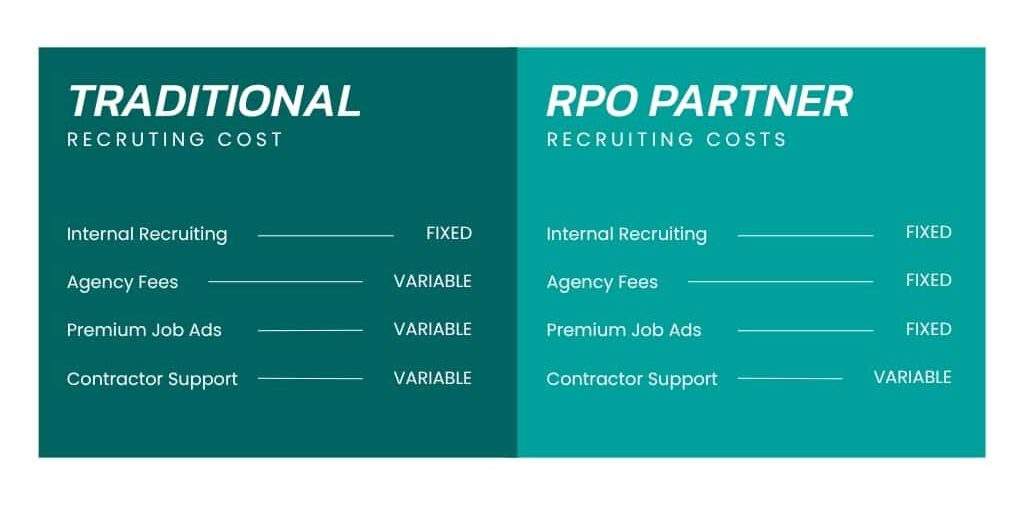
Internal hiring models often produce two layers of cost at once:
- Fixed internal payroll cost for recruiters and coordinators
- Variable spikes in spending when internal capacity is exceeded or pipelines collapse
That spike spend usually shows up in predictable places: contingency agencies, premium job advertising, signing incentives, and ad hoc recruiting contractors.
Many RPO agreements are structured as a monthly retainer, volume-banded pricing, or a hybrid of a base fee plus variable per-hire components. The structure matters less than the financial outcome.
RPO services provide hiring costs that are predictable and tied to expected hiring volume. When hiring demand is steady, a fixed or volume-banded RPO model makes recruiting costs easier to budget and easier to forecast.
Centralized Job Advertising Reduces Real Waste
Job advertising becomes expensive for two reasons: performance pricing and decentralization. Indeed describes sponsored jobs as performance-based pricing, with options such as pay-per-click or pay-per-started application depending on account setup.
Public employer reports indicate that cost-per-click frequently ranges from roughly $1 to $3 per click, though costs can climb higher in more competitive markets depending on job title and location. This variability means that without centralized governance, sponsored job budgets can drift upward quickly across multiple departments.
Waste typically comes from:
- Sponsoring roles that do not require sponsorship
- Letting sponsored campaigns run long after response declines
- Duplicating postings across boards because teams do not coordinate
- Renewing premium listings out of habit rather than performance
The RPO advantage is governance. A centralized team can set standards for:
- Which roles get sponsored
- What performance thresholds trigger changes
- When to stop spending
- How to compare channels consistently
The “savings rate” will vary by business, but the idea stays consistent: a controlled acquisition channel outperforms a fragmented one.
WorkRocket Premium Job Posting Savings
At WorkRocket, we take on the cost of posting jobs for your business to help you save money. Our relationship with Indeed allows us to create Premium job postings at a lower cost than you would pay for the same ad.
In one instance, our team partnered with a major gas and welding supply company to handle their job postings across a variety of job boards. By the end of the campaign, we reduced their total spending by about 27%.
Consistent Hiring Systems Reduce Early Turnover
Research consistently links stronger workforce management practices to better financial outcomes.
McKinsey & Company’s work on organizational health found that companies with stronger talent and management practices delivered three times the total shareholder returns of weaker organizations over the long term.
Gallup’s large meta-analysis of business units also found that organizations in the top quartile for engagement saw 23% higher profitability, 18% higher productivity, and 18% lower turnover in high-turnover environments.
Those outcomes depend heavily on who gets hired in the first place.
Selection research shows hiring methods with structured interview processes (like RPO) dramatically improve the accuracy of hiring decisions, which improves job fit and reduces the likelihood of early exits. A landmark meta-analysis by Schmidt and Hunter found that structured interviews are significantly more predictive of job performance than unstructured interviews.
Put simply: when you structure an interview with a well-defined criteria and consistent expectations, you do a better job selecting the people who will actually perform well in the role. When you find people that perform well in the role, they’re more likely to stay. This may seem like an obvious observation, but many companies still don’t structure their interviews well enough to make quality decisions.
In decentralized hiring environments, different managers screen candidates differently. Interview criteria change by location. Candidate expectations are set inconsistently. That variation increases the risk of poor role alignment and early exits.
RPO programs address that risk through process control.
A structured RPO model typically standardizes:
- Screening criteria
- Interview structure
- Candidate evaluation methods
- Communication of role expectations
- Recruiting-to-onboarding handoffs
The goal is to reduce variation in how hiring decisions are made.
Even modest improvements in early retention can produce meaningful operational impact.
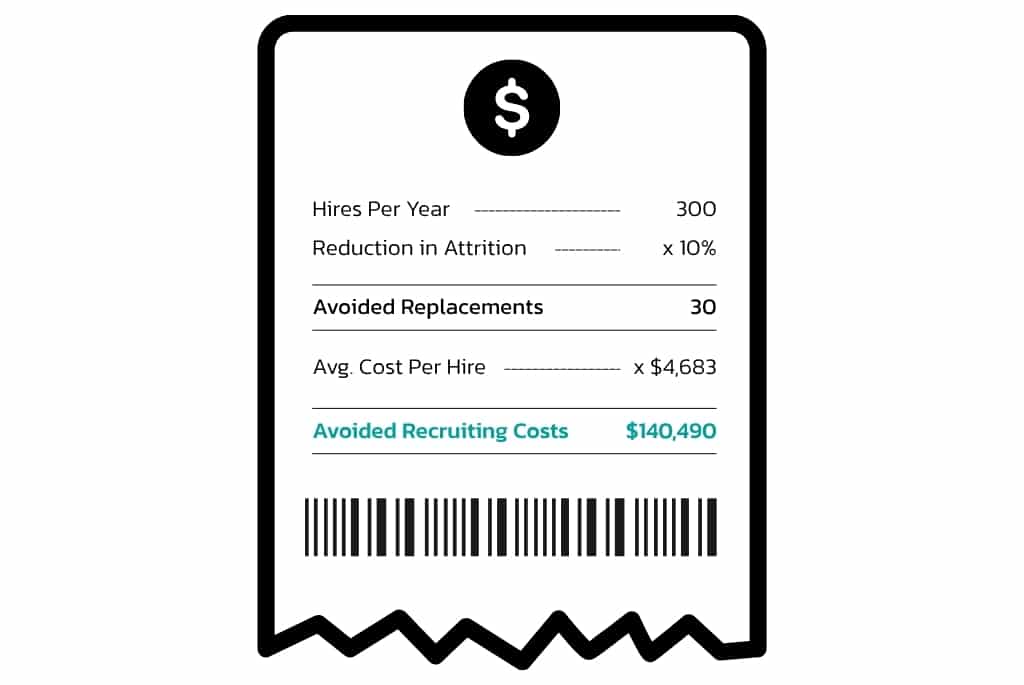
For example, if a company hires 300 employees annually and reduces first-year attrition by 10%, that prevents 30 replacement hires the following year. At an average cost-per-hire of $4,683, that represents more than $140,000 in avoided recruiting cost, before accounting for productivity losses or training expenses.
This is where recruiting infrastructure intersects with financial performance.
RPO improves the consistency of the hiring system that feeds the workforce. When hiring becomes more structured and predictable, avoidable turnover declines and replacement demand stabilizes.
That stability is what ultimately reduces recruiting cost volatility.
RPO Creates Leverage in HR Headcount Planning
Many organizations scale their internal recruiting team to handle peaks and then continue paying for that capacity when demand softens. Meanwhile, they still rely on agencies when demand spikes again and their team can’t handle the load.
SHRM benchmarking data reports a median of 20 requisitions per recruiter and an average of 67 requisitions per recruiter.
When req loads climb, internal teams hit a breaking point. That’s when agency use and job advertising spend tends to jump.
RPO introduces elasticity. It allows internal HR to retain what should stay internal:
- Policy and compliance ownership
- Employee relations
- Workforce planning
- Hiring manager accountability
And it shifts what is easiest to scale externally:
- Sourcing and pipeline management
- Screening and interview scheduling
- Candidate communication and coordination
- Advertising governance and reporting
With that division of labor, organizations can often avoid adding recruiters during growth cycles or reduce recruiter headcount over time, depending on volume and maturity. The more important point is that HR staffing decisions become intentional rather than reactive.
In one instance, WorkRocket partnered with a company that had an internal team of three recruiters and a variety of vendors that they worked with.
They came to us to help them find candidates for a role that they had consistently been struggling to fill. After using our services for a while and seeing the value we provided, the company was able to eliminate all their other vendors and reduce their recruiter staff to one.
The consistency of our services allowed this company to reduce their overhead expenses and replace a variable vendor cost with one consistent cost.
A Clean Way to Evaluate the Benefits Of RPO
The strongest arguments for RPO focus on what you can control instead of promising unrealistic savings. Here are a few things that an RPO service allows you to control:
- Spending predictability: fixed or volume-banded cost reduces variance
- Advertising governance: centralized sponsorship rules reduce drift
- Agency avoidance: fewer emergency placements when pipelines are maintained
- Capacity elasticity: internal HR headcount can stay leaner and more focused
- Process consistency: tighter selection and onboarding handoffs reduce avoidable churn
WorkRocket provides the recruiting infrastructure that makes recurring hiring measurable, governed, and forecastable.
Talk to us today to learn how we can help create consistency within your business.
