
By the time a maintenance technician role opens, the real problem is usually already underway.
Maybe a senior tech retired and took years of machine knowledge with him. Maybe the night shift has been relying on one person for too long. Maybe preventive maintenance keeps getting pushed back because the team is stuck reacting to breakdowns. By the time the job gets posted, you’re not just trying to fill a vacancy; you’re trying to protect uptime, reduce overtime pressure, and keep production from depending on a shrinking group of people.
That’s why open-market recruiting alone is a weak long-term strategy for maintenance roles. You may fill the next opening, but you’ll still be restarting the same search every time someone leaves.
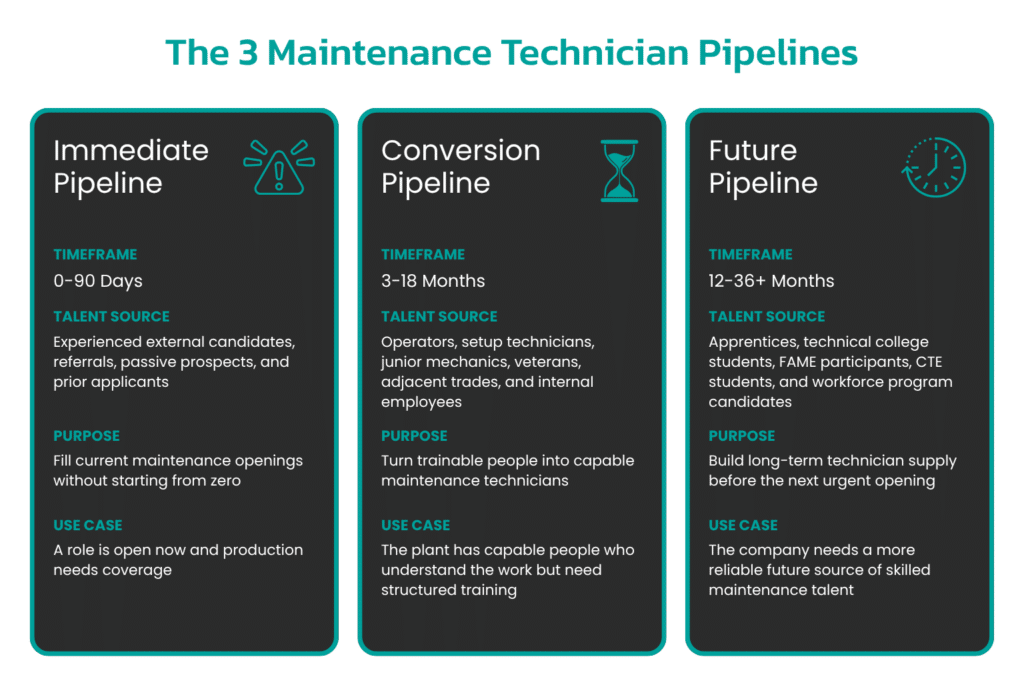
A stronger approach gives you three connected sources of talent: an immediate hiring pipeline for current openings, a conversion pipeline for people who can become technicians with the right training, and a future pipeline through apprenticeships, technical schools, and regional workforce partnerships.
Each pipeline serves a different purpose. Together, they make maintenance hiring less reactive and give you more control over where your next technician comes from. When you’re competing with every other manufacturing plant for the same role, these pipelines give you a competitive advantage.
A Maintenance Technician Pipeline Needs More Than One Source of Talent
A maintenance technician pipeline is more than a list of applicants. It’s a structured way to fill current openings, turn trainable people into maintenance techs, and build future technician supply before the next urgent requisition opens.
| Pipeline | Time Horizon | Main Talent Source | Primary Purpose |
| Immediate hiring pipeline | 0–90 days | Experienced external candidates, referrals, passive prospects, prior applicants | Fill current maintenance openings without starting from zero |
| Conversion pipeline | 3–18 months | Operators, setup technicians, junior mechanics, veterans, adjacent trades, internal employees | Turn trainable people into entry-level or mid-level maintenance technicians |
| Future pipeline | 12–36+ months | Apprentices, technical college students, FAME participants, CTE students | Build long-term technician supply before requisitions open |
The immediate pipeline helps you respond when a role is open now. The conversion pipeline reduces your dependence on fully experienced outside candidates. The future pipeline helps you create technicians before the market hands them to someone else.
Build the Immediate Hiring Pipeline for Current Maintenance Openings
Your immediate hiring pipeline is the system you use when a maintenance role is open now. It still matters, even if you’re building internal training paths and apprenticeship relationships, because the line needs coverage today.
The difference is that immediate hiring should run like a managed sourcing and screening process, not a one-time posting.
Identify Markets with Qualified Candidates
Before you post the role, identify where qualified or partially qualified maintenance candidates are likely to exist in your market.
That may include:
- Nearby manufacturers
- Industrial service companies
- Millwrights and equipment repair firms
- Facilities maintenance teams with industrial exposure
- HVAC technicians, diesel mechanics, electricians, and other adjacent trades
- Military maintainers
- Former applicants
- Referrals from your current maintenance team
- Passive candidates already working similar shifts
This keeps you from relying on job boards as the whole strategy. Some experienced maintenance technicians are not actively searching, but they may be open to better shift structure, stronger equipment exposure, clearer advancement, or a shorter commute. If your recruiting process does not reach those people directly, you’re only competing for a fraction of the potential candidates.
Keep Sourcing Active After the Job Goes Live
A strong immediate pipeline needs a weekly rhythm. You should know whether the search is short on candidates, short on qualified candidates, stuck in manager review, or losing people because the process is too slow.
Each week, review applicant quality, recontact past maintenance candidates, source passive prospects, ask for targeted referrals, and check where candidates are stalling. If the pipeline is weak, adjust the sourcing strategy before the search drags into another month.
Screen for Maintenance Readiness
The immediate pipeline shouldn’t be judged by applicant volume alone. It should be judged by how many screened candidates are worth a maintenance leader’s time.
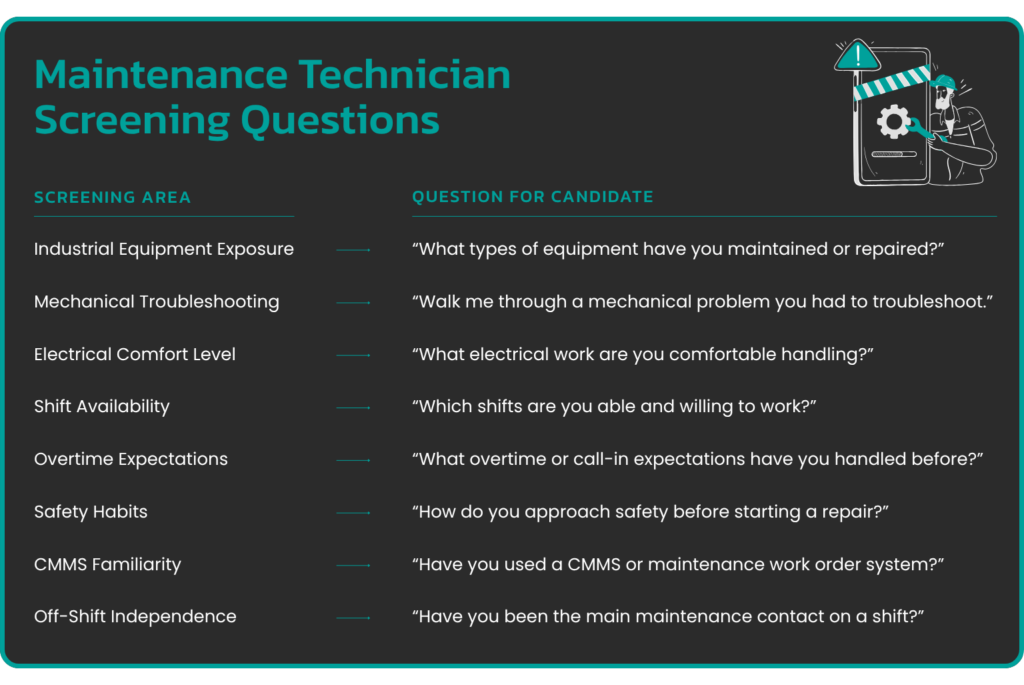
For maintenance roles, screen for:
- Industrial equipment exposure
- Mechanical troubleshooting experience
- Electrical comfort level
- Shift availability
- Overtime and call-in expectations
- Safety habits
- CMMS familiarity
- Ability to work independently on off-shifts
- Whether the candidate is senior, mid-level, or trainable
That last point is important. Someone who’s not ready for a senior multi-craft role may still be worth tracking for a junior maintenance opening, trainee path, or future conversion opportunity.
Move Quickly Once Qualified Candidates Surface
Current maintenance openings often stall after qualified candidates are found. A recruiter screens someone, the candidate is interested, and then the hiring manager takes several days to review the resume or schedule the interview. By the time the process moves again, the candidate has taken another call.
You need feedback standards before candidates enter the funnel. Set a 24-48 hour review expectation, identify one clear decision-maker, use a simple scorecard for maintenance readiness, avoid surprise interview rounds, and make sure offer approval is not delayed after finalist interviews.
For current openings, track more than time to fill. Track qualified applicants by source, screen-to-interview conversion, interview-to-offer conversion, offer acceptance, hiring-manager response time, cost per hire, internal hours saved, and first-90-day retention.
Our Gibbs Die Casting case study shows how this can work for maintenance hiring. Across three targeted Industrial Maintenance Mechanic campaigns, we generated 55 qualified applicants, supported four hires, helped Gibbs reclaim 37 hours of internal time, and achieved an average cost per hire of $2,249.25.
That’s the role of the immediate pipeline: cleaner candidate flow, faster manager focus, and less internal time spent sorting through people who are not a fit.
Build a Conversion Pipeline for People with Related Skills
The conversion pipeline answers a different question: who could become a maintenance technician with structured training, even if they’re not ready today?
Many plants already employ people who understand the equipment, pace, safety expectations, shift culture, and production pressure. They may not have the full maintenance skill set yet, but they’re closer to the work than a cold external candidate.
Look for Feeder Roles Inside and Near the Plant
Good conversion candidates often come from roles that already touch the equipment or understand downtime pressure.
These may include:
- Machine operators who know how equipment behaves when something starts to drift
- Setup technicians who understand changeovers, adjustments, tooling, and line readiness
- Production leads who understand downtime pressure and shift coordination
- Junior mechanics who need a clearer path into higher-skill maintenance work
- Facilities maintenance workers with mechanical, electrical, HVAC, or repair experience
- Military maintainers with troubleshooting discipline, safety habits, and documentation practices
- Adjacent tradespeople from HVAC, diesel, electrical, or mechanical backgrounds
The goal is not to move anyone who shows interest into maintenance. The goal is to identify people with enough aptitude, curiosity, and work discipline to justify the training investment.
Create a Bridge Between Production and Maintenance
A conversion pipeline needs a real role between production and a fully qualified technician position. That role might be maintenance trainee, level I maintenance technician, apprentice maintenance mechanic, or junior industrial maintenance technician.
The title matters less than the structure of the role. The person needs useful work, clear expectations, and a visible path forward. Early responsibilities may include preventive maintenance support, lubrication routes, equipment inspections, basic mechanical repairs, parts staging, CMMS entry, shadowing troubleshooting calls, assisting with line changeovers, and learning lockout/tagout procedures.
That bridge role gives the plant extra production capacity while the employee builds skills. It also gives the employee a defined place inside the maintenance function.
Build Training Paths Around Skills
A conversion path works best when employees can see how they progress. Build a skill matrix that separates foundation skills, mechanical work, electrical basics, fluid power, troubleshooting, and advanced technical skills. Then tie progression to demonstrated skill.
This structure gives employees a credible advancement path, and it gives you a defensible way to decide when someone is ready for higher pay, independent PM work, on-call responsibility, or more complex troubleshooting.
Structured training matters because informal shadowing varies by mentor, shift, workload, and urgency. The National Institute of Standards and Technology’s Training Within Industry resource says companies using Train Within Industry (TWI) have seen the time to develop new hires into productive workers cut in half, along with reductions in scrap and rework.
The broader lesson is straightforward: repeatable instruction works better than unstructured exposure when you need people to become productive faster.
You should also measure the conversion pipeline separately from external recruiting. Track employees assessed for aptitude, employees accepted into the trainee path, skill-matrix completion, time to independent PM work, Level I to Level II progression, mentor hours used, converted technician retention, and reduction in external searches for entry-level maintenance roles.
Build the Future Pipeline Before the Next Maintenance Opening Exists
The future pipeline is the long-term supply engine. It includes apprenticeships, technical colleges, FAME chapters, high school CTE programs, internships, co-ops, plant tours, and regional workforce partnerships.
This pipeline takes longer to produce hires, but it gives you influence over how future technicians are trained before they enter the labor market. In a labor market that’s already thin and isn’t expected to grow anytime soon, this pipeline gives you the opportunity to target candidates before they ever have a chance to consider your competitors.
Start with the Role You Need to Create
Before you approach a school or workforce partner, define the job outcome you need the program to support.
You may need future:
- Entry-level industrial maintenance technicians
- Maintenance mechanics
- Mechatronics technicians
- Multi-craft trainees
- Automation maintenance technicians
- Process technicians
That answer should shape the curriculum, work experience, mentor structure, and skill expectations. Without defining this in the beginning, you may support general training that doesn’t match your equipment, shifts, safety requirements, or maintenance structure.
Use Apprenticeships When the Role Needs Structure
Registered apprenticeships can be valuable when you need an employer-connected path rather than a loose relationship with a school.
A U.S. Department of Labor evaluation of registered apprenticeship programs under the American Apprenticeship Initiative found that 46 of 68 surveyed employers (68%) achieved a positive net return over the five years after the apprenticeship ended when direct and indirect benefits were counted. The median return was $144 for every $100 invested.
FAME, the Federation for Advanced Manufacturing Education, gives manufacturers another relevant model. The Advanced Manufacturing Technician students gain experience in electricity, robotics, fluid power, mechanics, fabrication, industrial troubleshooting, and related areas, with graduates receiving an associate degree and 1,800 hours of on-the-job training and work experience. The National Association of Manufacturers reports more than 1,300 enrolled students, 2,200 graduates, and a 90% employment rate upon graduation.
Structured training programs like these can produce employer value over time. For maintenance hiring, the value is employer-connected, work-based learning tied to the skills modern plants need.
Automation Changes What the Pipeline Has to Produce
Automation doesn’t remove the need for maintenance technicians. It changes what your maintenance technician pipeline has to produce.
Modern plants need people who can work across mechanical and technical systems, including sensors, robotics, conveyors, HMIs, electrical troubleshooting, PLC exposure, fluid power, CMMS documentation, predictive maintenance tools, and mechanical/electrical crossover work.
This is another reason the three-pipeline model matters. Some advanced skills need to be hired immediately. Some can be taught through internal conversion. Others should be built into apprenticeship and school partnerships before the need becomes urgent.
Instead of searching for one technician who already knows every system, decide which advanced skills you must buy now, which skills you can build through internal conversion, and which skills belong in your future pipeline.
Where Outside Recruiting Support Fits
Outside recruiting support is most useful for the immediate hiring pipeline.
It can help you source experienced candidates, reach passive prospects, screen for maintenance readiness, manage campaign activity, communicate with candidates, report on pipeline health, and reduce the internal time spent on unqualified applicants.
Outside recruiting does not replace your conversion or future pipeline. You still need internal training, mentor capacity, skill matrices, wage progression, apprenticeships, technical school relationships, and plant leadership commitment. But outside recruiting support can keep today’s searches moving while those longer-term pipelines mature.
A better recruiting process can fill the next maintenance technician opening. A real maintenance technician pipeline makes the next opening less disruptive.
If you’re struggling with your immediate hiring pipeline, WorkRocket offers recruitment process outsourcing services that may be able to help you take care of your immediate hiring needs. Our team works closely with the manufacturing industry and is experienced in sourcing candidates for maintenance technician roles. To learn more about the process, reach out to our team!
